Table of Contents
- Why Beaverton? Understanding Oregon’s Silicon Forest Advantage
- Strategic Housing Choices: Finding Your Home in Beaverton’s Competitive Market
- Getting Around the Silicon Forest: Commute Strategies for Tech Professionals
- Work-Life Integration: Dining, Recreation & Culture in Beaverton
- Action Plan: Your Relocation Checklist for Beaverton
- Key Takeaways
Imagine building your tech career in a place where competitive salaries meet lower living costs, where a quick commute doesn’t mean sacrificing quality of life, and where world-class outdoor recreation is just an hour away. Welcome to Beaverton, Oregon—the heart of the Pacific Northwest’s “Silicon Forest.”
Since the 1980s, this tech ecosystem has evolved from its hardware manufacturing roots into a diverse innovation hub that rivals traditional tech centers like Silicon Valley. Today, Beaverton offers something increasingly rare in the tech industry: the opportunity to advance your career while actually improving your quality of life. With software development jobs projected to grow 18.2% between 2022-2032—significantly outpacing national averages—and a mean annual wage of $146,080 for software developers paired with a median home price of $555,000, the math is compelling.
The region’s appeal extends beyond spreadsheets. Intel’s 22,000+ employees work at the world’s largest Intel site just minutes away in Hillsboro, while Nike’s 13,300-employee world headquarters anchors Beaverton itself. But it’s not just about the giants—a thriving ecosystem of startups and mid-sized firms creates opportunities across the full spectrum of tech careers.
This guide provides everything you need to know about relocating to Beaverton: from understanding the Silicon Forest’s career opportunities to finding the right neighborhood, mastering your commute, and discovering why so many tech professionals are choosing Oregon’s premier tech hub over more traditional options.
Why Beaverton? Understanding Oregon’s Silicon Forest Advantage
The “Silicon Forest” isn’t just clever marketing—it’s a tech ecosystem with genuine depth and staying power. Born in the 1980s when pioneers like Tektronix and Intel established major operations in Washington County, the region has matured into one of the nation’s most significant technology clusters. While the lush Pacific Northwest landscape inspired the “Forest” part of the name, it’s the concentration of innovation that makes the comparison to Silicon Valley apt.
Today’s Silicon Forest has evolved far beyond its hardware manufacturing origins. While Washington County’s manufacturing sector—still dominated by computer and electronics production—remains the largest private industry by employment, the ecosystem now encompasses software development, advanced R&D, clean technology, and digital innovation. This diversification provides career stability that single-industry tech hubs can’t match.
The Economic Engine: Major Employers and Growth Trajectory
Intel Corporation remains the undisputed anchor of the Silicon Forest. While headquartered in California, Intel’s Oregon operations represent the company’s largest and most comprehensive site globally. With over 22,000 employees in Washington County, Intel is Oregon’s largest private employer. The campuses in neighboring Hillsboro—including the massive Ronler Acres and Jones Farm facilities—function as global hubs for cutting-edge semiconductor research, development, and manufacturing.
Recent developments signal even more growth ahead. Intel’s $8.5 billion federal CHIPS Act grant will fuel massive expansion of its Oregon operations, solidifying the region’s role in America’s semiconductor industry and creating thousands of additional high-paying tech jobs. For relocating professionals, this represents long-term career security backed by federal investment.
Nike, Inc. brings a different dimension to Beaverton’s tech landscape. While globally recognized for athletic apparel, Nike is fundamentally a technology and innovation company. Its World Headquarters occupies a sprawling campus within Beaverton’s city limits, employing approximately 13,300 people. The company invests heavily in digital technology, data analytics, supply chain innovation, and product development—creating substantial opportunities for tech professionals who might not have considered working for an apparel company.
Beyond these Fortune 500 anchors, Beaverton’s tech ecosystem thrives with diversity:
- Analog Devices employs over 900 people in semiconductor design and manufacturing
- Synopsys, Inc. provides critical software and intellectual property for semiconductor design
- Tektronix, one of the original Silicon Forest pioneers, continues operations in test and measurement equipment
- Qorvo contributes to the region’s RF and wireless technology capabilities
Perhaps most exciting for career-minded professionals is the growing startup and mid-sized company scene. The region’s established tech infrastructure, access to talent from Oregon’s universities, and proximity to venture capital has spawned a vibrant ecosystem of emerging companies. This creates opportunities beyond the corporate ladder at major employers—you can join early-stage companies with growth potential or move between established firms and startups throughout your career.
The Compensation Advantage: Where Your Dollar Goes Further
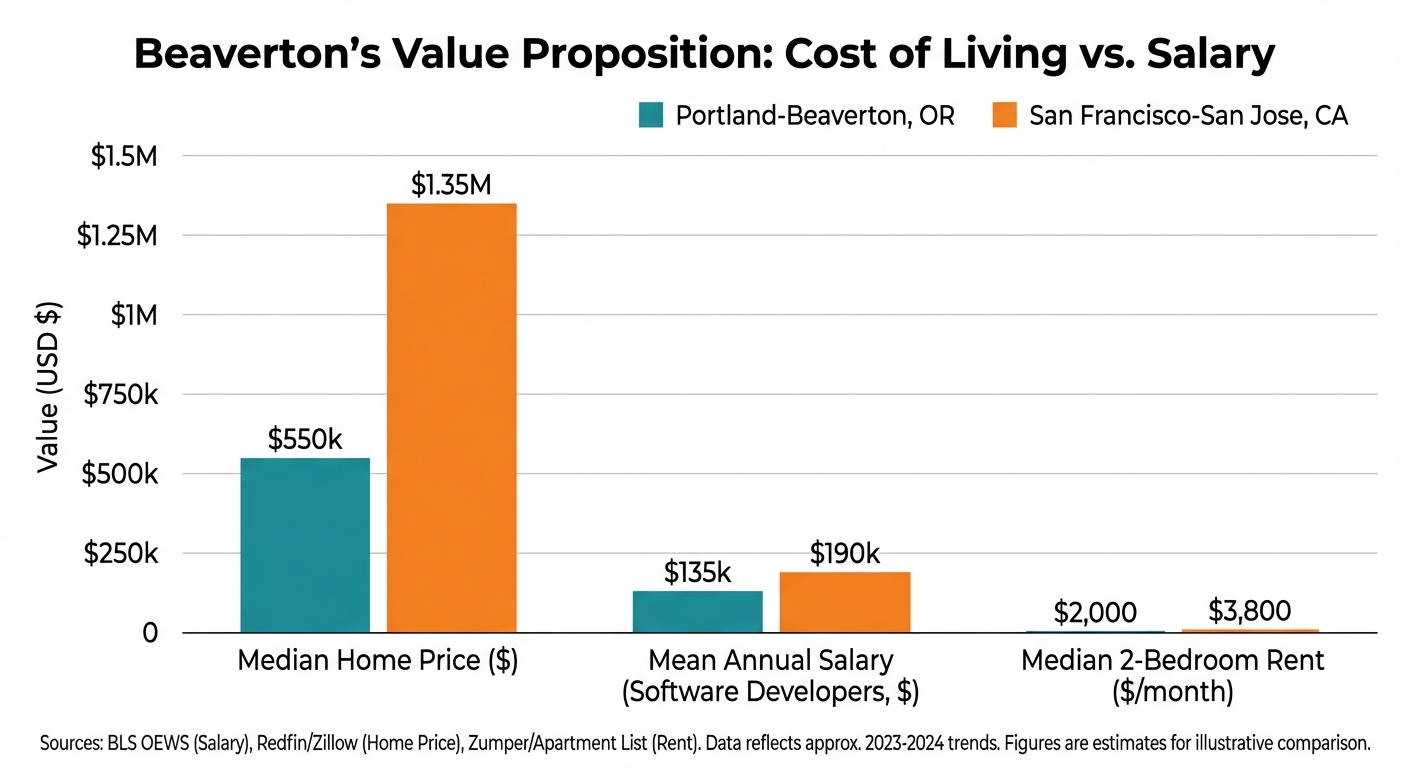
The Silicon Forest offers a compelling financial proposition when you run the numbers. Software developers in the Portland-Vancouver-Hillsboro metropolitan statistical area earn a mean annual wage of $146,080. While this may be nominally lower than Bay Area salaries, the cost-of-living differential often results in significantly higher discretionary income.
Consider the housing comparison: Beaverton’s median home price of $555,000 is substantially lower than San Francisco or San Jose, where median prices regularly exceed $1.3 million. This means a tech professional making $146,000 in Beaverton can afford a significantly better quality of life—larger homes, shorter commutes, more savings—than a colleague making $180,000 in the Bay Area.
The broader cost-of-living picture reinforces this advantage. Everything from dining out to childcare, from state income taxes to transportation costs, tends to be lower in the Portland metro area compared to traditional tech hubs. For professionals weighing relocation options, Beaverton offers the rare combination of robust tech career opportunities with financial breathing room that’s increasingly hard to find when buying a home elsewhere.
Strategic Housing Choices: Finding Your Home in Beaverton’s Competitive Market
Finding the right home in Beaverton requires understanding both market dynamics and strategic neighborhood selection. The region offers diverse housing options—from dense, transit-oriented developments to classic suburban neighborhoods with mature trees and larger lots. Your choice should align not just with your housing preferences but with your lifestyle priorities and commute logistics.
Understanding the Market Reality
Beaverton’s real estate market reflects its strong employment base and high quality of life. As of October 2023, the median sale price for homes in the Beaverton/Aloha area stood at $555,000. The market typically operates as a seller’s market with tight inventory—approximately 2.3 months of supply, meaning homes move quickly when priced appropriately.
For context, Beaverton’s median household income is $85,617, while Washington County overall averages $98,171—both comfortably above Oregon’s state median of $75,656. These income levels, driven largely by the tech sector, support the housing market and create competitive conditions for desirable properties.
If you’re not ready to purchase immediately or want to learn the market before committing, the rental market offers accessible entry points. The median rent for a two-bedroom apartment in Beaverton is approximately $1,800, providing a way to establish yourself locally while house hunting strategically.
Neighborhood Profiles: Matching Location to Lifestyle
The key to housing satisfaction in Beaverton is matching neighborhood character with your commute priorities and lifestyle preferences. Three distinct areas offer different advantages for tech professionals.
Cedar Hills / Cedar Mill: Nike-Proximate Suburban Living
For professionals working at Nike’s World Headquarters, Cedar Hills and Cedar Mill offer the ultimate in commute convenience—just 5-15 minutes to the campus. These unincorporated areas just north and northeast of the Nike campus blend established suburban character with convenient access to urban amenities.
The housing stock is diverse: mid-century homes with character and mature landscaping, contemporary single-family homes, townhouses, and garden-style apartments. You’ll find rolling hills, tree-lined streets, and a sense of established community. The area’s crown jewel is Tualatin Hills Nature Park, offering 222 acres of forests, streams, and trails—a quick escape to nature between morning standups and evening code reviews.
Shopping and services are convenient at Cedar Hills Crossing and Timberland Town Center, while the highly-rated Beaverton School District serves the area—a crucial consideration for families. The neighborhood strikes a balance between suburban tranquility and accessibility to both Nike’s campus and the broader Silicon Forest employment centers via OR-217.
South Beaverton / Murrayhill: The Central Hub
South Beaverton and Murrayhill represent classic American suburbia done well. These established neighborhoods feature primarily single-family homes built from the 1980s through the 2000s, often on larger lots than you’ll find in newer developments. The vibe is decidedly community-oriented—think neighborhood parks, community centers, and tree-lined streets where kids still play outside.
For tech professionals, the central location is the key advantage. You’re 10-20 minutes from Nike’s headquarters, and OR-217 provides efficient access to Hillsboro’s Intel campuses in 15-25 minutes. This makes South Beaverton ideal if you’re not certain where your career will take you within the Silicon Forest—you maintain reasonable commute times to multiple major employers.
Progress Ridge TownSquare offers walkable shopping and dining, while Murrayhill Park provides recreational amenities. The Beaverton School District’s strong reputation extends throughout these neighborhoods, making them particularly attractive to families with school-age children.
Orenco Station / Tanasbourne: Intel-Focused Transit Living
If you’re joining Intel or another Hillsboro tech employer, Orenco Station and Tanasbourne deserve serious consideration. Technically in Hillsboro rather than Beaverton proper, these neighborhoods have become synonymous with Silicon Forest living.
Orenco Station is nationally recognized as one of America’s premier transit-oriented developments. Built around the MAX Light Rail Blue Line, the neighborhood features a dense, walkable core with mixed-use buildings—condos, townhomes, and apartments above retail—surrounded by newer single-family homes in adjacent areas. The design philosophy prioritizes walkability and community: you can grab coffee, pick up groceries, and meet neighbors without ever getting in your car.
For Intel employees, the commute mathematics are compelling: 5-15 minutes by car, or a traffic-free MAX ride of similar duration directly to Intel’s campuses. The MAX connection also provides easy access to downtown Portland for entertainment or urban exploration without driving.
Tanasbourne, adjacent to Orenco, offers The Streets of Tanasbourne—a major retail hub—along with a vast array of apartment complexes and single-family homes. The housing tends to be newer construction, with modern amenities and energy efficiency built in.
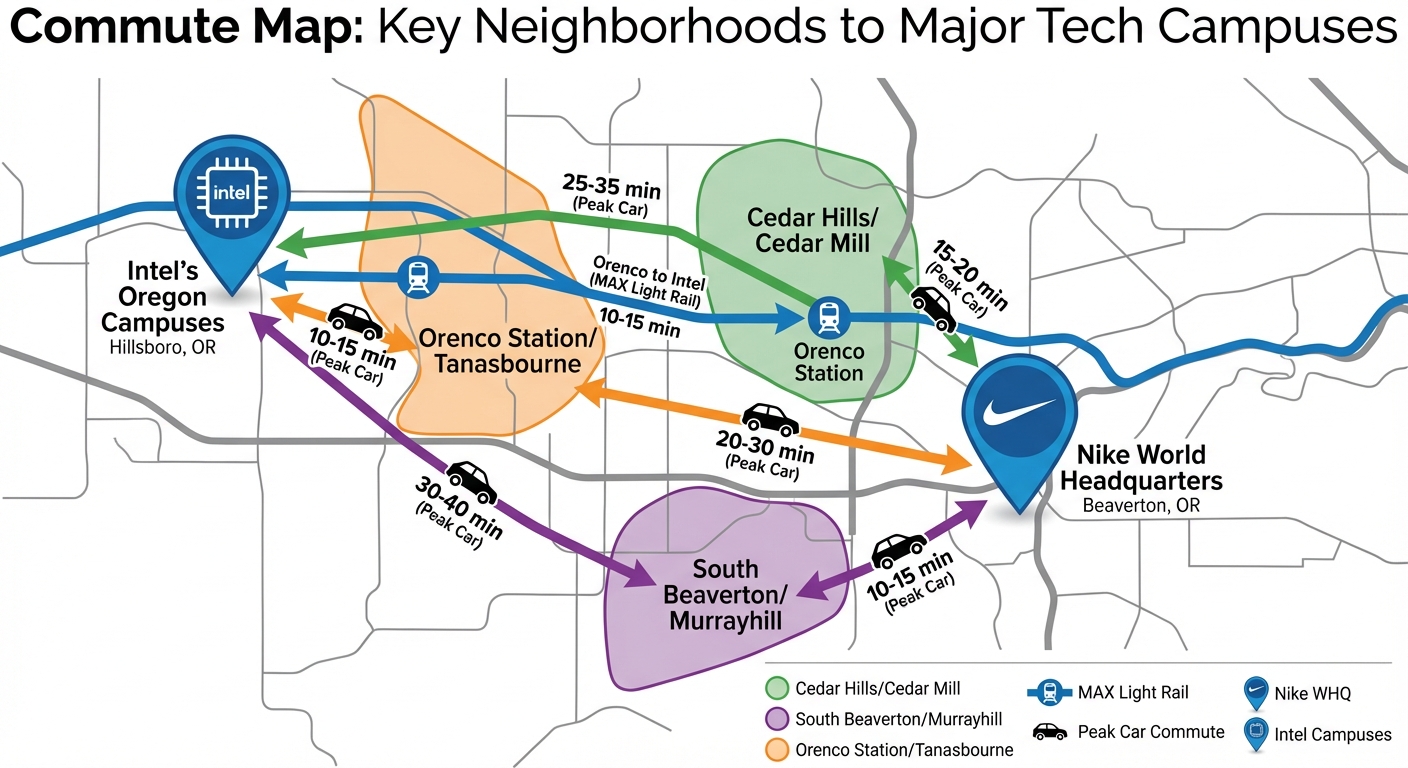
The choice between these neighborhoods ultimately depends on your priorities: Do you value proximity to a specific employer? Do you prefer traditional suburban living or a more urban, walkable environment? Are excellent schools essential, or are you more focused on entertainment and dining access? Understanding these trade-offs helps you focus your housing search on areas that truly match your needs.
Getting Around the Silicon Forest: Commute Strategies for Tech Professionals
Your daily commute fundamentally shapes your quality of life, and Beaverton offers multiple strategies for getting to work. Understanding the transportation infrastructure—from driving patterns to public transit advantages to emerging cycling options—helps you make informed decisions about where to live and how to structure your workday.
The Driving Reality: Routes and Congestion
Most Beaverton residents drive to work, with a mean commute time of 23.9 minutes—slightly below the national average. The region’s primary commute corridors include U.S. Route 26 (Sunset Highway), the main east-west artery connecting Beaverton to downtown Portland and points west, and Oregon Route 217, which provides critical north-south connectivity.
However, there’s an important caveat: Portland metro ranks among the top 25 most congested urban areas in the United States. During peak hours, particularly on Route 26 and OR-217, traffic can significantly extend your commute time. What looks like a 15-minute drive on Google Maps at 2 PM might become 35 minutes at 8 AM.
The good news is that Silicon Forest employment patterns differ from traditional downtown-centric commutes. Nike’s Beaverton campus and Intel’s Hillsboro facilities create diverse traffic flows rather than everyone converging on a single downtown core. This means that while congestion exists, it’s often less severe than what you’d experience in cities with central business districts.
Smart driving strategies help: flexible work hours that allow you to miss peak traffic, understanding alternate routes for when main corridors are jammed, and choosing housing locations that minimize time on the most congested segments.
MAX Light Rail: Your Traffic-Free Alternative
The MAX Light Rail system represents Beaverton’s competitive advantage for certain commute patterns. The Blue Line runs directly through central Beaverton, connecting the Beaverton Transit Center eastward through downtown Beaverton to Hillsboro (Intel campuses) and westward to downtown Portland.
For professionals working at Intel, the MAX offers a game-changing option. The Orenco Station stop was specifically designed to serve Intel’s workforce, providing direct access to major campus buildings. A typical commute from Beaverton Transit Center to Intel’s Ronler Acres campus takes approximately 25 minutes via MAX—completely traffic-free, predictable, and productive (you can actually work on your laptop while commuting).
The Portland connection is similarly convenient: Beaverton Transit Center to downtown Portland is roughly 30 minutes on the MAX. This makes living in Beaverton viable even if you work downtown, and it provides weekend access to Portland’s urban attractions without the hassle and expense of parking.
For Nike employees, the MAX equation is less direct—Nike’s campus isn’t on the rail line—but bus connections from MAX stations to Nike are available and can work well if you prefer avoiding traffic entirely.
Additional Transit and Active Transportation Options
Beyond the MAX, TriMet’s extensive bus network serves neighborhoods throughout Beaverton, connecting to transit centers and major employers. The WES Commuter Rail provides weekday service between Beaverton and Wilsonville, useful for those working at southern employment hubs.
Cycling is becoming increasingly viable for Beaverton commutes. The city’s Active Transportation Plan is systematically building a network of safe, connected bikeways and walkways. Major employers recognize this trend—both Nike and Intel provide secure bike storage and shower facilities at their campuses, making bike commuting practical year-round (yes, even in the rain—proper gear makes a huge difference).
The typical cycling commute from central Beaverton neighborhoods to Nike is 15-25 minutes, to Intel campuses 25-35 minutes. For professionals seeking exercise integration into their daily routine or those committed to sustainable transportation, cycling represents a viable option supported by improving infrastructure.
Airport Access for the Frequent Traveler
For business travel or personal trips, Portland International Airport (PDX) is approximately 30-45 minutes from Beaverton by car outside peak traffic. PDX consistently ranks among America’s best airports for its efficiency, local food options, and overall experience.
Public transit access is straightforward: take the MAX Blue Line from Beaverton and transfer to the Red Line, which serves the airport directly. This takes roughly 50-60 minutes but eliminates parking costs and allows you to work or relax during the journey.
Understanding your commute options before choosing a neighborhood is crucial. Run the scenarios: How often will you need to be physically in the office versus working from home? Do you value commute predictability over absolute minimum time? Are you willing to embrace public transit or cycling to improve quality of life? Your answers should directly inform your housing search strategy.
Work-Life Integration: Dining, Recreation & Culture in Beaverton
Career opportunities and affordable housing matter, but what makes a place truly worth living in is what happens outside work hours. Beaverton delivers on the Pacific Northwest lifestyle promise: exceptional dining, unparalleled outdoor recreation access, and a growing cultural scene that rivals much larger cities.
Culinary Diversity: From Food Carts to Fine Dining
Beaverton has emerged as a legitimate culinary destination, offering far more than typical suburban chain restaurants. The city’s Restaurant Row on SW Watson Avenue features acclaimed eateries serving diverse international cuisines—from authentic Korean and Japanese to innovative American and fusion concepts.
One of Beaverton’s most distinctive culinary experiences is BG’s Food Cartel, one of the largest food cart pods in the entire region. This expansive collection offers dozens of options representing global cuisines: Thai, Vietnamese, Mexican, Mediterranean, Caribbean, and more. The food cart culture allows chefs to experiment and innovate without the overhead of traditional restaurants, resulting in exceptional quality at reasonable prices. It’s become a genuine community gathering spot—a place to grab lunch with coworkers, meet friends after work, or introduce newcomers to Portland’s food scene.
The broader Tualatin Valley extends Beaverton’s culinary appeal into world-class wine country. As part of Oregon’s renowned Willamette Valley, the region hosts numerous vineyards and wineries within a short drive. Ponzi Vineyards and Cooper Mountain Vineyards offer tastings, events, and beautiful settings—perfect for weekend afternoons or entertaining visiting friends and family.
Oregon’s craft beer reputation is well-earned, and Beaverton contributes to it with several excellent local breweries. The beer culture here is serious but unpretentious—a reflection of the broader Pacific Northwest ethos of quality without pretension.
Outdoor Recreation: Where Nature Meets Urban Convenience
Ask any Pacific Northwest transplant what surprised them most, and many will say: “I didn’t realize how close everything is.” From Beaverton, you’re approximately 90 minutes from both the Oregon Coast and the Cascade Mountains. This isn’t theoretical access—people genuinely go skiing at Mount Hood on Saturday morning and return home by dinner, or spend Sunday at Cannon Beach watching waves without feeling like they’ve undertaken an expedition.
Locally, the Tualatin Hills Park & Recreation District (THPRD) manages one of Oregon’s most comprehensive park systems: over 100 park sites, 70 miles of trails, and extensive recreational facilities throughout the Beaverton area. The district’s crown jewel, Tualatin Hills Nature Center, offers 222 acres of forests, streams, and wildlife right in the middle of suburbia—a genuine escape that’s accessible on your lunch break or after work.
The THPRD system includes sports facilities, swimming pools, community centers, and organized recreational programs. For families, this infrastructure is invaluable. For individuals, it provides structured ways to meet people, stay active, and engage with the community beyond work.
The outdoor access fundamentally changes your relationship with work-life balance. Stressful week at work? You can be hiking in old-growth forest or kayaking in pristine waters within a couple of hours. This proximity to world-class outdoor recreation isn’t just a nice perk—it’s a lifestyle transformation that many tech professionals cite as a primary reason they relocated and stayed in the Pacific Northwest.
Arts, Culture, and Professional Networking
Beaverton is actively investing in its cultural infrastructure. The Patricia Reser Center for the Arts, which opened recently, is a world-class performance venue hosting diverse programming: music ranging from classical to contemporary, theater productions, dance performances, and cultural events. The facility represents Beaverton’s commitment to becoming not just an employment hub but a complete community with rich cultural offerings.
The Beaverton Farmers Market, rated as one of the nation’s best, operates seasonally and has become a major community institution. Beyond fresh produce and local goods, it serves as a social hub where neighbors connect, families spend Saturday mornings, and newcomers begin to feel like locals.
For professional integration, the Technology Association of Oregon (TAO) hosts numerous networking events, workshops, and conferences throughout the Portland metro area. These gatherings provide opportunities to connect with peers across the Silicon Forest, learn about emerging trends, and build the professional relationships that often lead to career advancement or new opportunities. For relocating professionals, TAO membership offers a structured way to build your local network immediately.
The combination of these elements—culinary diversity, outdoor recreation access, cultural development, and professional networking opportunities—creates the conditions for genuine work-life integration. You’re not just surviving between weekends; you’re building a life that balances professional growth with personal fulfillment, all in one of America’s most beautiful regions.
Action Plan: Your Relocation Checklist for Beaverton
Understanding Beaverton’s advantages is one thing; actually executing a successful relocation requires practical planning and smart timing. This section provides an actionable framework for making your move as smooth as possible.
Timing Your Move Strategically
Real estate markets follow seasonal patterns, and Beaverton is no exception. Spring and summer typically see increased inventory as families prefer moving between school years, but this also means higher competition and potentially stronger seller negotiating positions. Fall and winter often offer better opportunities for negotiation, with less competition and sellers more motivated to close before the holidays.
For families with school-age children, aligning your move with the Beaverton School District calendar minimizes disruption. The highly-rated district operates on a traditional September-to-June calendar, making summer moves ideal. If your children are mid-school-year, connecting with schools early helps ensure smooth enrollment and support for the transition.
Many major Silicon Forest employers offer comprehensive relocation packages—particularly Intel and Nike, which regularly recruit national and international talent. Don’t leave money on the table: negotiate aggressively for relocation assistance, temporary housing support, and even home-buying incentives. These packages can substantially offset moving costs and make Beaverton even more financially attractive.
Pre-Move Research: Knowledge Before Commitment
Before signing a lease or making an offer, invest time in understanding Beaverton firsthand. Virtual tours and online research provide a foundation, but nothing replaces physically experiencing neighborhoods during actual commute times. Schedule a reconnaissance visit that includes:
- Morning and evening drives along your potential commute route to experience real traffic patterns
- Neighborhood walks at different times of day to understand community character
- Visits to local amenities like grocery stores, parks, and restaurants to assess day-to-day convenience
- Campus tours of your prospective employer to understand the work environment and nearby services
Connect with Beaverton’s tech community before you arrive. Join Portland-area tech groups on LinkedIn, participate in relevant Slack communities, or attend Technology Association of Oregon events remotely if possible. These connections provide insider knowledge, potential networking leads, and even social opportunities for when you arrive.
Essential Resources for Execution
Working with real estate professionals who specialize in tech relocations makes a measurable difference. These agents understand the specific needs of Silicon Forest professionals: commute optimization, school district quality, resale potential, and the nuances of competing in Beaverton’s market. They can provide insights that generic real estate searches miss.
Monitor the Regional Multiple Listing Service (RMLS) market reports monthly to understand pricing trends and market conditions. This knowledge helps you recognize good deals and make competitive offers when you find the right property.
Utilize city resources systematically: the City of Beaverton’s website provides neighborhood guides, information about major employers, and details on the Active Transportation Plan. TriMet’s trip planner allows you to test public transit options before committing to specific neighborhoods—a crucial tool if you’re considering a MAX-dependent lifestyle.
Integration Tactics: Becoming a Local, Not Just a Resident
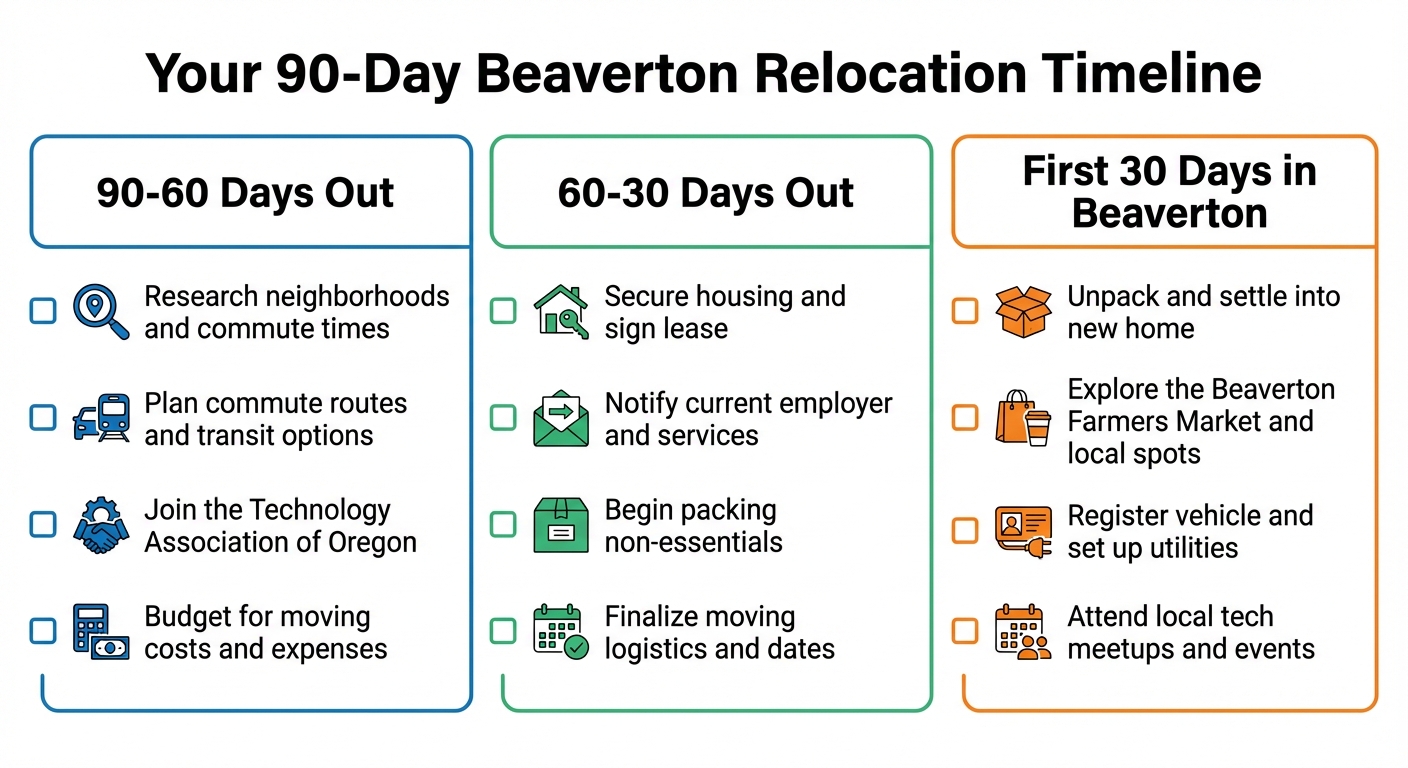
Your first 90 days in Beaverton set the tone for your entire experience. Immediately join the Technology Association of Oregon for networking and industry insights. Attend their events even if networking feels awkward initially—these connections often lead to career opportunities, collaborations, and genuine friendships.
Participate in THPRD programs and activities that match your interests: recreational sports leagues, fitness classes, cultural programs, or volunteer opportunities. These structured activities provide natural ways to meet people beyond work colleagues.
Systematically explore the region: schedule weekend trips to wine country, the Oregon Coast, and the Cascade Mountains. Understanding what’s accessible transforms these from tourist attractions into regular parts of your life. Many long-term residents maintain traditions—first snowfall means a Mount Hood trip, sunny summer weekends mean beach visits—that root them in the Pacific Northwest experience.
Don’t underestimate the importance of finding “your places”—the coffee shop where you become a regular, the trail you hike weekly, the restaurant that feels like your spot. These anchors transform Beaverton from “where I relocated for work” into “home.”
Key Takeaways
Beaverton represents something increasingly rare in today’s tech landscape: a place where robust career opportunities align with genuinely improved quality of life. The Silicon Forest isn’t just marketing—it’s a mature, diversified tech ecosystem anchored by Intel’s 22,000 employees and Nike’s 13,300-person headquarters, supported by a thriving landscape of startups and mid-sized companies, and backed by federal investment through the $8.5 billion CHIPS Act grant.
The financial equation works in your favor. A mean software developer salary of $146,080 combined with a median home price of $555,000 creates tangible advantages over traditional tech hubs. You’re not just making slightly less money—you’re building more wealth, enjoying better housing, and maintaining higher quality of life because your dollar stretches further.
The neighborhoods offer genuine choice: proximity-focused living near Nike in Cedar Hills, balanced suburban life in South Beaverton, or transit-oriented modernity in Orenco Station. Each serves different priorities while maintaining access to the broader Silicon Forest opportunity landscape.
Transportation infrastructure provides flexibility: drive when convenient, take the MAX for traffic-free commutes, or embrace cycling as infrastructure continues improving. You’re not locked into a single strategy, and you can adapt as your circumstances change.
Perhaps most importantly, Beaverton delivers on the Pacific Northwest lifestyle promise. World-class dining, 90-minute access to both mountains and coast, a comprehensive park system, growing cultural institutions, and a tech community that values work-life integration over performative hustle culture.
The region’s continued growth—18.2% projected increase in software development jobs through 2032—demonstrates long-term stability. Ongoing infrastructure investment, from the Active Transportation Plan to the Patricia Reser Center, shows a community committed to becoming even more livable.
In Beaverton’s Silicon Forest, you’re not just joining a tech hub—you’re integrating into a community that values innovation, sustainability, and genuine work-life balance at the heart of one of America’s most beautiful regions. For tech professionals willing to look beyond traditional coastal hubs, Beaverton offers something better: a place where you can build both a successful career and a life you actually want to live.
Ready to Make the Move?
Discover how Beaverton’s Silicon Forest can transform your tech career and lifestyle. Get personalized guidance on finding the perfect home in Oregon’s premier tech hub.
References:
- Technology Association of Oregon. (n.d.). The Oregon Tech Story. Retrieved from https://www.techoregon.org/the-oregon-tech-story/
- Oregon Employment Department. (2023). Washington County: A Profile of the Region and its Workforce. Retrieved from https://www.qualityinfo.org/documents/10182/79018/Washington+County%3A+A+Profile+of+the+Region+and+its+Workforce
- Oregon Employment Department. (2023). 2022-2032 Employment Projections. Retrieved from https://www.qualityinfo.org/projections-industry-occupation?area=000041&time=29
- Intel Corporation. (2023). Intel in Oregon. Retrieved from https://www.intel.com/content/www/us/en/corporate-responsibility/intel-in-oregon.html
- The Oregonian/OregonLive. (2023). Intel to receive $8.5 billion federal grant for chip factory expansion, modernization. Retrieved from https://www.oregonlive.com/silicon-forest/2024/03/intel-to-receive-85-billion-federal-grant-for-chip-factory-expansion-modernization.html
- Portland Business Journal. (2023). Nike to lay off 740 at world headquarters in second round of cuts. Retrieved from https://www.bizjournals.com/portland/news/2024/04/26/nike-layoffs-beaverton-whq.html
- City of Beaverton. (2024). Major Employers. Retrieved from https://www.beavertonoregon.gov/283/Major-Employers
- RMLS. (2023, November). Market Action, October 2023. Retrieved from https://www.rmlsweb.com/v2/public/media/MA_10_2023.pdf
- U.S. Census Bureau. (2023). QuickFacts: Beaverton city, Oregon; Washington County, Oregon; Oregon. Retrieved from https://www.census.gov/quickfacts/fact/table/beavertoncityoregon,washingtoncountyoregon,OR/PST045223
- TriMet. (n.d.). MAX Blue Line. Retrieved from https://trimet.org/max/
- City of Beaverton. (n.d.). Beaverton Restaurant Row. Retrieved from https://www.beavertonoregon.gov/790/Downtown-Dining-and-Restaurant-Row
- Tualatin Valley. (n.d.). Wineries, Vineyards & Tasting Rooms. Retrieved from https://tualatinvalley.org/wineries-vineyards/
- Tualatin Hills Park & Recreation District. (n.d.). About Us. Retrieved from https://www.thprd.org/district-information/about-us
- The Patricia Reser Center for the Arts. (n.d.). About The Reser. Retrieved from https://thereser.org/about/
- Business Oregon. (2023). Oregon CHIPS Act. Retrieved from https://www.oregon.gov/biz/programs/oregonchipsact.aspx
- Built In Portland. (2024). Top Tech Companies & Startups in Portland. Retrieved from https://www.builtinportland.com/companies
- U.S. Bureau of Labor Statistics. (2023, May). Occupational Employment and Wages, Portland-Vancouver-Hillsboro, OR-WA – Software Developers. Retrieved from https://www.bls.gov/oes/current/oes_38900.htm#15-1252
- Council for Community and Economic Research. (2023). Cost of Living Index. Data accessible via paid reports and frequently cited by economic development agencies.
- Zumper. (2024). Beaverton, OR Rent Prices. Retrieved from https://www.zumper.com/rent-research/beaverton-or
- Niche. (2024). Beaverton School District Rankings. Retrieved from https://www.niche.com/k12/d/beaverton-school-district-or/
- TomTom. (2023). Traffic Index: Portland. Retrieved from https://www.tomtom.com/traffic-index/portland-traffic/
- City of Beaverton. (n.d.). Active Transportation Plan. Retrieved from https://www.beavertonoregon.gov/435/Active-Transportation-Plan