Table of Contents
Selling a home represents one of the largest financial transactions most people will experience in their lifetime. The process requires careful navigation of legal requirements, market dynamics, and transactional procedures that can feel overwhelming without proper guidance. In Oregon, sellers face unique considerations—from mandatory disclosure requirements to regional market conditions—that significantly impact the outcome of their sale.
The Oregon real estate market has entered a normalization period after years of rapid appreciation, creating a more balanced environment where strategic preparation is essential. Federal interest rate policies have significantly influenced buyer demand, with the 30-year fixed mortgage rate fluctuating between 6-7% throughout 2023-2024. This elevated rate environment has made buyers more price-sensitive and selective, meaning sellers must approach the market with greater strategic precision than during the frenzied pandemic years.
This comprehensive guide breaks down the entire selling process into four distinct phases: Pre-Listing Preparation, Listing & Marketing, Offers & Negotiations, and Escrow & Closing. Understanding Oregon-specific requirements—including mandatory seller disclosures, local environmental concerns like radon and underground oil tanks, and regional market data from RMLS™—is critical for a successful transaction.
By the end of this guide, you’ll understand each decision point, timeline expectation, and legal requirement necessary to maximize your sale price while minimizing stress. Whether you’re a first-time seller or a seasoned homeowner, this roadmap will help you navigate the Oregon home-selling journey with confidence.
Strategic Pricing, Home Preparation, and Due Diligence

The success of your home sale is largely determined before you ever list. This critical pre-listing phase involves three fundamental elements: strategic pricing through market analysis, preparing your home for maximum appeal, and addressing Oregon-specific inspection concerns. Getting this foundation right sets the trajectory for your entire transaction.
Strategic Pricing Through Comparative Market Analysis
Setting the right initial asking price is arguably the most critical decision in the selling process. Overpricing costs sellers time and money—homes requiring price reductions spend a median of 35 days on market versus just 11 days for correctly priced homes. In today’s rate-sensitive environment, overpricing can be particularly detrimental as buyers carefully calculate their purchasing power.
A proper Comparative Market Analysis (CMA) evaluates recently sold properties of similar size, location, and condition using RMLS™ data. This isn’t simply averaging nearby sale prices; it requires nuanced adjustments for neighborhood appeal, unique features, property condition, and current inventory levels. An experienced agent analyzes active listings (your competition), pending sales (current market activity), and recently closed transactions (proven market value) to arrive at an optimal price range.
Pricing psychology matters significantly. Listing at $749,000 instead of $750,000 ensures your home appears in searches for buyers with a $750,000 maximum budget. In Oregon’s current market, where elevated mortgage rates have heightened buyer price sensitivity, accurate initial pricing is more critical than ever. Strategic pricing doesn’t mean undervaluing your home—it means positioning it competitively to attract qualified buyers quickly and generate strong offers.
The Measurable Impact of Home Staging and Professional Photography
In today’s digital-first real estate market, presentation is paramount. Most buyers form their first impression online, making staging and professional photography essential marketing tools, not luxuries.
Home staging involves professionally preparing your property to showcase its best features and help buyers visualize themselves living there. The data supporting staging is compelling: 81% of buyers’ agents report that staging helps buyers visualize the property as their future home. More significantly, 23% of sellers’ agents report staging increases offer prices by 1-5%, with another 18% reporting increases of 6-10%.
Professional DSLR photography produces measurably better results than smartphone photos. Research shows that homes listed with professional photography sell for thousands more and are more likely to sell within six months compared to those with amateur photos. In the post-pandemic market, 3D virtual tours (such as Matterport) have become standard expectations, allowing remote property assessment before in-person showings. These virtual walkthroughs give out-of-town buyers the ability to narrow their search and seriously consider your property without an initial physical visit.
Oregon-Specific Pre-Sale Improvements and Due Diligence
Strategic home improvements before listing can yield substantial returns, but not all projects are created equal. According to Remodeling Magazine’s 2023 Cost vs. Value Report for the Pacific Region, garage door replacement delivers an impressive 196% ROI, while minor kitchen remodels recoup approximately 97% of their cost. Fresh interior paint, with a typical investment of $3,000-5,000, provides high visual impact for relatively modest expense.
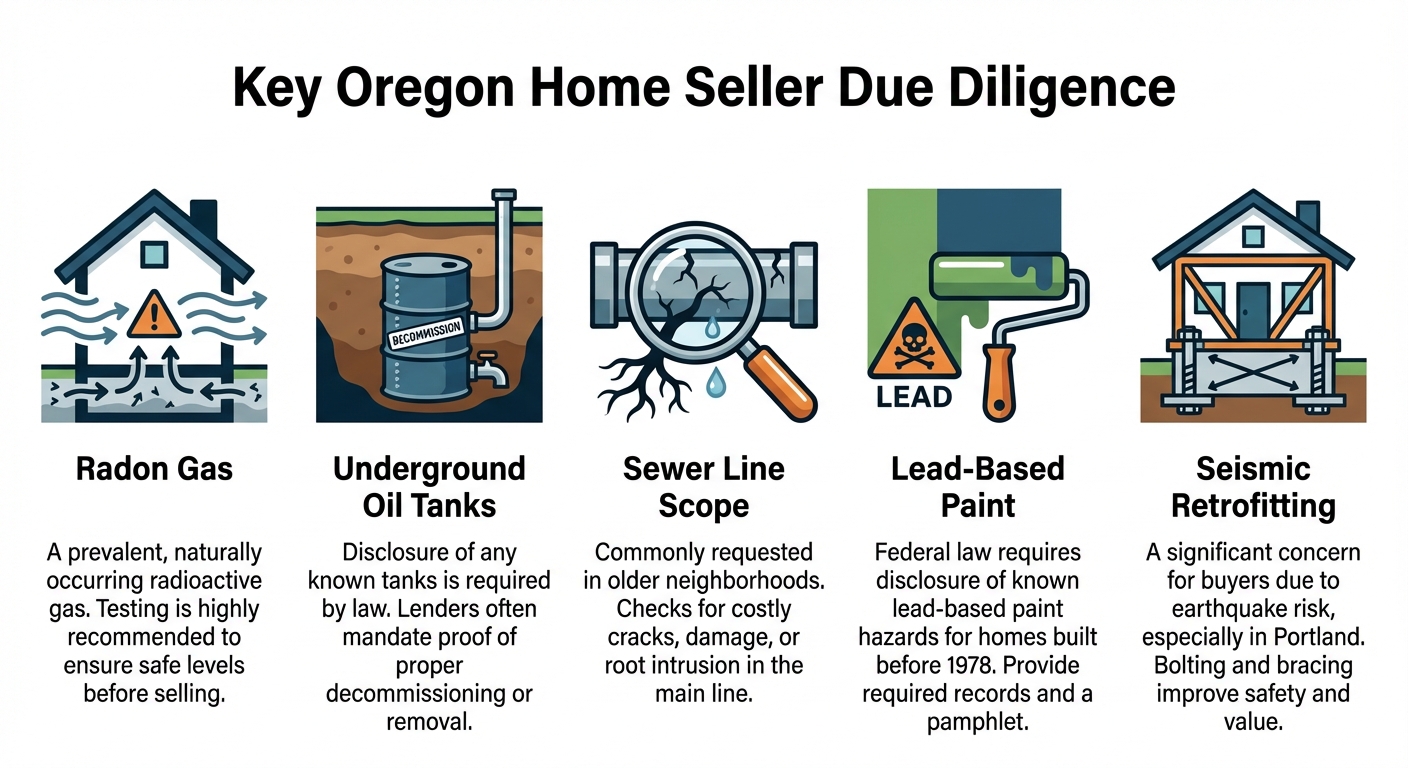
Pre-listing inspections allow sellers to identify issues early, enabling proactive resolution or appropriate pricing adjustments. This transparency can streamline negotiations and build buyer confidence. Oregon sellers face several state-specific considerations that require attention:
Radon Testing: The Oregon Health Authority recommends testing all homes for radon, a naturally occurring radioactive gas and leading cause of lung cancer prevalent throughout the state. Disclosing radon levels is part of the seller’s duty, and mitigation systems can be installed if necessary.
Underground Oil Tanks: Many older Oregon homes used heating oil, and abandoned underground tanks pose environmental risks. The Oregon Department of Environmental Quality requires proper decommissioning, and sellers must disclose known tanks. Most lenders mandate proof of proper decommissioning or removal before approving financing.
Sewer Line Scoping: Particularly important in older neighborhoods, cracked or root-damaged sewer lines can cost thousands to repair. A pre-listing sewer scope identifies issues before they become buyer objections or deal-killers.
Lead-Based Paint Disclosure: Federally required for homes built before 1978, sellers must provide buyers with a lead-based paint disclosure pamphlet and any known information about lead paint presence.
Seismic Retrofitting: While not mandatory for sale, earthquake-conscious buyers increasingly consider seismic anchoring, especially in Portland and other areas with older housing stock. The City of Portland provides resources for residential seismic strengthening that can add value and buyer confidence.
Strategic Marketing and Professional Presentation
Once your home is prepared, a comprehensive marketing strategy maximizes exposure to qualified buyers. Effective marketing combines the foundational power of the Multiple Listing Service with modern digital strategies and strategic timing.
The Power of the Multiple Listing Service
The RMLS™ (Regional Multiple Listing Service) serves as the primary distribution channel for Portland-area properties and surrounding regions. Listing on the MLS provides automatic syndication to major real estate websites including Zillow, Redfin, and Realtor.com, while simultaneously reaching thousands of licensed agents who represent active buyers.
The accuracy and compelling presentation of your MLS entry directly impacts online engagement and showing requests. Detailed property descriptions, accurate measurements, high-quality photos, and comprehensive feature lists ensure your home stands out in search results and captures buyer attention.
Modern Multi-Channel Marketing Strategies
Successful home marketing extends well beyond the MLS. A comprehensive digital marketing suite includes professional listing photos, video walkthroughs, and 3D virtual tours embedded in online listings. Social media advertising through targeted Facebook and Instagram campaigns showcases property highlights to demographically appropriate audiences.
Agent networking remains powerful—email campaigns to active buyer’s agents in the local market often generate qualified showings from buyers already working with representation. Professional brochures and feature sheets for showings and open houses provide takeaway materials that keep your property top-of-mind.
The “Coming Soon” strategy has gained popularity, building anticipation before going active on MLS to create urgency among buyers monitoring the market. This pre-marketing period can generate strong initial interest and potentially multiple offers when the property officially lists.
Strategic Timing Considerations
Spring and early summer traditionally offer the largest buyer pools in the Pacific Northwest, driven by families wanting to relocate before the school year and favorable weather for house hunting. However, counter-intuitively, listing during slower seasons like late fall or winter can reduce competition and attract serious buyers who need to purchase regardless of season.
Current inventory levels should influence timing decisions. In markets with lower inventory, sellers enjoy leverage regardless of season, while high-inventory markets favor waiting for peak buyer activity periods.
Managing Showings and Open Houses
Flexibility is essential during the showing period. Sellers must be prepared to vacate with short notice for private showings, as buyers often have limited availability and properties showing the most flexibility typically receive more showing requests.
Electronic lockboxes provide secure access for licensed agents while tracking showing activity—valuable data for understanding buyer interest levels. Open houses offer a low-pressure environment for buyers to tour properties, generate valuable feedback, and create a competitive atmosphere when multiple attendees are present. Systematic collection of agent and buyer feedback allows strategy adjustments if showing activity isn’t translating to offers.
Beyond the Price – Understanding What Makes a Strong Offer

Receiving an offer initiates a critical evaluation period. Understanding the components of a strong offer—beyond just the purchase price—is essential for making informed decisions that protect your interests and maximize the likelihood of a successful closing.
Anatomy of a Strong Offer
While purchase price is obviously important, several other factors significantly impact offer strength and deal security.
Financing Type: Cash offers eliminate appraisal and financing contingencies, providing maximum certainty. Conventional loans with greater than 20% down payment indicate stronger buyer financial position compared to FHA or VA loans with minimal down payments. While FHA and VA financing serve important purposes, they typically involve stricter property condition requirements and longer closing timelines.
Earnest Money Deposit: Higher deposits—typically exceeding 1% of the purchase price—signal serious buyer commitment. Earnest money becomes non-refundable once contingencies are removed, so larger deposits demonstrate buyer confidence and financial capacity.
Contingency Evaluation: Each contingency represents an “exit door” allowing buyers to cancel without penalty. Common contingencies include financing approval, satisfactory home inspection, appraisal meeting purchase price, and selling their current home. Fewer contingencies with shorter timeframes mean more security for sellers.
Closing Date Flexibility: Alignment with your preferred timeline can be a powerful negotiating tool. If you need extra time to find your next home, a buyer offering extended closing may be more valuable than one demanding quick possession.
Escalation Clauses: In multiple-offer situations, escalation clauses automatically increase the offer price to beat competitors up to a pre-set maximum. For example, an offer with a $5,000 escalation up to $800,000 would automatically increase to $5,000 above any competing offer, capped at the maximum.
| Offer Component | Stronger for Seller | Weaker for Seller |
|---|---|---|
| Financing | Cash; Conventional >20% down | FHA/VA; Low down payment |
| Earnest Money | >1% of price | Minimal or none |
| Contingencies | Few or waived | Multiple with long timelines |
| Closing Timeline | Matches seller preference | Rushed or very distant |
| Escalation Clause | Included (competitive market) | Not included |
Oregon’s Mandatory Seller’s Property Disclosure Statement
Oregon law (ORS 105.465) mandates that sellers of 1-4 unit residential properties provide detailed disclosure of property condition. This is one of the most important legal requirements in the Oregon selling process.
The Seller’s Property Disclosure Statement is a comprehensive multi-page form requiring sellers to answer detailed questions about their property’s condition to the best of their knowledge. This is not a warranty or guarantee—it represents the seller’s actual knowledge at the time of completion.
Material defects—conditions that could significantly affect property value or a buyer’s purchase decision—must be disclosed. These might include foundation issues, roof leaks, plumbing problems, electrical defects, pest infestations, environmental hazards, or any other condition substantially affecting the property.
Failure to disclose known material defects can result in legal action even after the sale closes. Oregon courts have held sellers liable for non-disclosure, making honest, thorough completion of this form essential for protecting yourself from post-closing claims. The Oregon Real Estate Agency provides the official form and guidance for completion.
The Negotiation Process
Upon receiving an offer, sellers have three options: accept as-is, reject, or counter-offer. Negotiation is a dynamic process that can involve not just purchase price, but also seller credits toward buyer closing costs, closing date adjustments, included items like appliances or fixtures, and even rent-back agreements allowing sellers to remain in the property briefly after closing.
In multiple offer situations, strategic evaluation of competing offers based on overall strength—not just highest price—often yields better outcomes. A slightly lower all-cash offer with no contingencies may provide greater certainty than a higher-priced offer with multiple contingencies and questionable financing.
Once all parties agree to all terms and sign the documents, mutual acceptance occurs. The property moves to “pending” status, and the formal escrow timeline begins.
From Contract to Keys – Navigating Oregon’s Escrow Process
Oregon is an “escrow state,” meaning a neutral third party manages the closing process to ensure all contractual conditions are met before ownership transfers. Understanding this structured process helps set realistic expectations and reduces anxiety during what can feel like a lengthy waiting period.
Understanding the Oregon Escrow Timeline
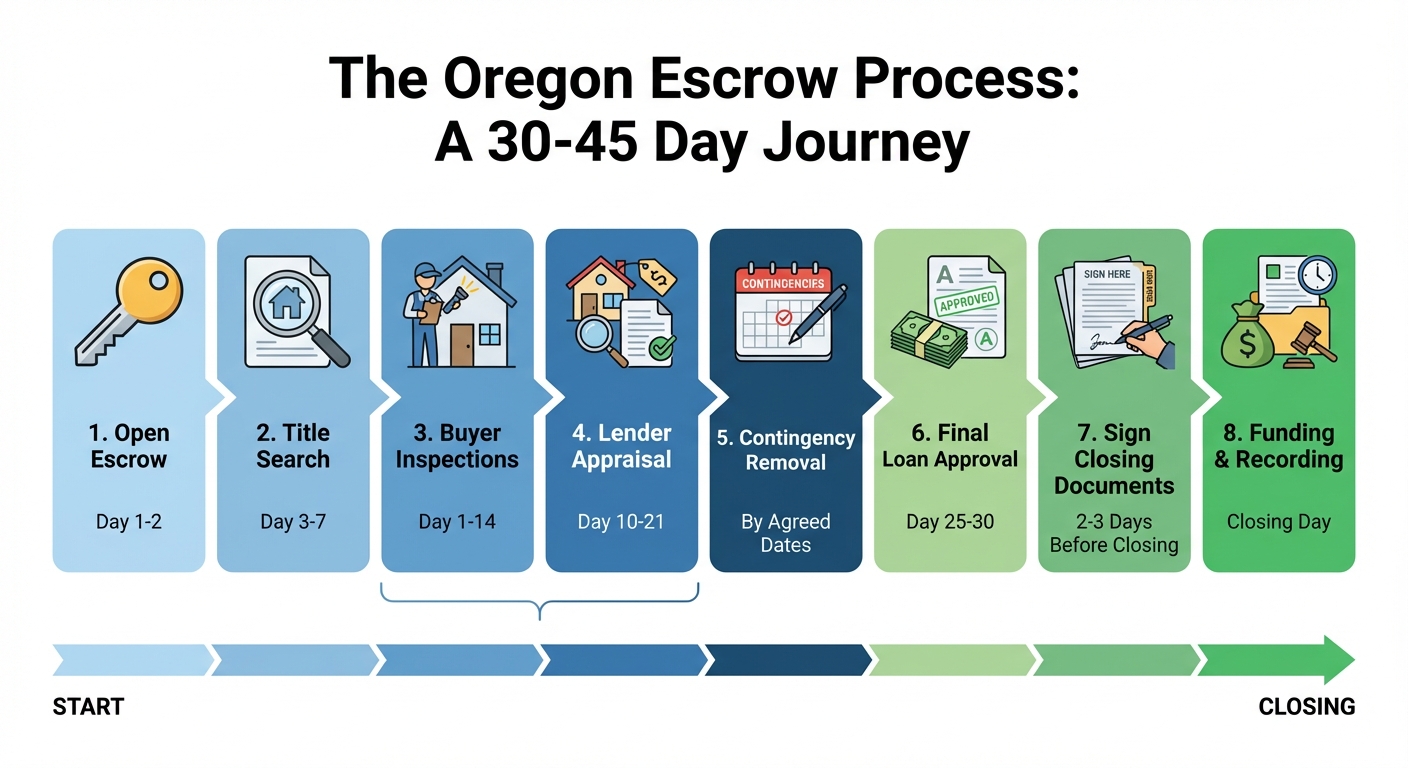
The typical Oregon escrow period lasts 30-45 days, though this can vary based on the specific terms negotiated in the Sale Agreement. Here’s what happens during this time:
Day 1-2: Escrow Opens
The signed Sale Agreement is delivered to the escrow company, and the buyer deposits earnest money into the escrow account. This money is held in a trust account until closing or contract termination.
Day 3-7: Title Work Begins
The title company searches public records for liens, easements, encumbrances, or other issues that could affect ownership transfer. A preliminary title report is issued to both buyer and seller, revealing any title issues requiring resolution before closing.
Day 1-14: Buyer Due Diligence Period
This critical period allows the buyer to conduct comprehensive property evaluation. The buyer arranges home inspection, radon testing, sewer scope, and any other desired inspections. They review seller disclosures and the preliminary title report while working toward final loan approval.
If inspection reveals issues, repair negotiations may occur. Sellers can choose to make repairs, offer credits, adjust the purchase price, or refuse concessions. Buyers must decide whether to proceed, renegotiate, or exercise their inspection contingency to cancel.
Day 10-21: Appraisal
For financed purchases, the lender orders an appraisal to confirm the property value supports the loan amount. If the appraisal comes in below the purchase price, renegotiation may be necessary. Buyers might need to increase their down payment, sellers might agree to reduce the price, or parties might meet somewhere in the middle.
Agreed-Upon Dates: Contingency Removal
Once satisfied with inspections, title review, and financing approval, the buyer formally removes contingencies. After contingency removal, the earnest money typically becomes non-refundable, significantly strengthening the deal from the seller’s perspective.
Day 25-30: Final Loan Approval
The buyer receives “clear to close” from their lender, and final loan documents are prepared. Any remaining conditions must be satisfied before the lender will fund the loan.
2-3 Days Before Closing: Document Signing
Buyer and seller sign their respective closing documents with the escrow officer. Unlike some states, Oregon practice typically has parties sign separately rather than together at a closing table.
Closing Day: Funding and Recording
The buyer’s lender wires funds to escrow, and the escrow officer verifies receipt. Once all conditions are met, escrow authorizes the title company to send the deed to the county for official recording. The sale is legally complete only when the deed is recorded in the public record. Once recording is confirmed, the seller receives proceeds via wire transfer, and keys are transferred to the buyer.
Understanding Seller Closing Costs
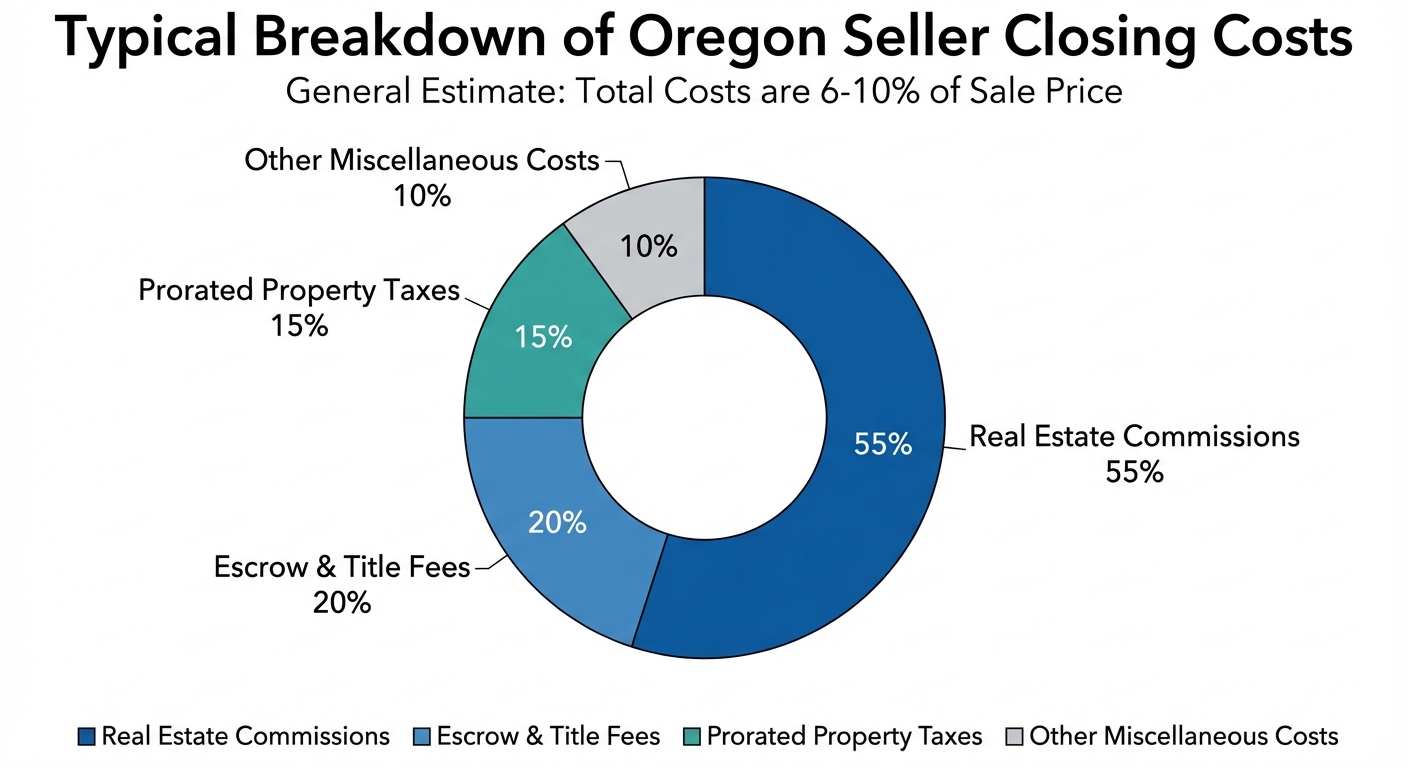
Oregon sellers are responsible for several costs at closing. While these vary by transaction, typical expenses include:
Real Estate Agent Commissions: The largest expense, traditionally structured as a percentage of the sale price. This has historically been split between the listing agent and buyer’s agent, though recent legal settlements have created new transparency requirements and negotiation dynamics.
Escrow Fees: Professional services of the escrow officer who manages the transaction, document preparation, and fund disbursement. These fees are often split 50/50 between buyer and seller.
Owner’s Title Insurance Policy: A one-time premium for a policy protecting the buyer from future claims against the title. This insurance provides coverage if title issues emerge after closing that weren’t discovered during the title search.
Prorated Property Taxes: Sellers pay their proportionate share of property taxes through the closing date, with the buyer assuming responsibility from closing forward.
Washington County Transfer Tax: Oregon has no statewide real estate transfer tax, but Washington County levies a transfer tax of $1 per $1,000 of the sale price, typically split between buyer and seller. This is an exception rather than the rule across Oregon.
Other Potential Costs: HOA transfer fees, recording fees for deed or lien releases, payoff of existing mortgages or home equity lines of credit, and any seller credits negotiated during offer acceptance.
Sellers should typically budget 6-10% of the sale price for all closing costs, though this can vary significantly based on the specifics of your transaction and local customs.
Understanding When the Sale is Officially Complete

Closing day represents the culmination of the selling process, but understanding the specific sequence of events ensures no surprises during this final stage.
The Document Signing Process
The primary documents sellers sign include the statutory warranty deed—the legal document transferring ownership from seller to buyer—and the settlement statement (Closing Disclosure), which provides a detailed, itemized breakdown of all financial debits and credits.
Oregon’s standard practice involves separate signings, with the buyer and seller meeting with the escrow officer individually rather than sitting together at a closing table. This approach offers scheduling flexibility and reduces the pressure of face-to-face interaction during what can be an emotional transaction.
The Critical Sequence on Closing Day
The exact sequence of events on closing day is important to understand:
- All parties have signed their respective documents
- The buyer’s lender funds the loan by wiring money to escrow
- Escrow verifies receipt of all funds
- Escrow authorizes the title company to record the deed with the county clerk
- The deed is officially recorded in the public record
- Recording confirmation is received by escrow
- Escrow disburses seller proceeds via wire transfer
- Possession transfers to the buyer per agreement terms
- Keys are delivered to the buyer
The sale is not legally complete until the deed is recorded in the county’s public records. This is the definitive moment when ownership officially transfers from seller to buyer.
Important Timing Considerations
The “closing date” specified in your contract is the target date, but actual recording may occur later in the day or even the following day depending on county recorder office procedures and any last-minute issues requiring resolution.
Funds are not released to the seller until recording is confirmed. This protects all parties by ensuring the legal transfer is complete before money changes hands. Plan your moving logistics with a slight buffer for potential recording delays—avoid scheduling movers or travel arrangements that require accessing sale proceeds at a specific time on closing day.
Final Thoughts
Selling your Oregon home successfully requires strategic preparation, market knowledge, legal compliance, and careful execution through each phase of the transaction. From conducting an accurate comparative market analysis and preparing your home with high-impact improvements, to understanding the nuances of Oregon’s mandatory disclosure requirements and navigating the structured escrow timeline, each decision point influences your final outcome.
The current Oregon market demands more from sellers than the rapid appreciation years of the past. Buyers are more price-sensitive due to elevated mortgage rates, making accurate initial pricing, professional presentation, and transparency about property condition more critical than ever. The sellers who succeed are those who approach the process strategically, working with experienced professionals who understand both the procedural requirements and local market dynamics.
By understanding the detailed timeline outlined in this guide—from pre-listing preparation through the final recording of the deed—you’re better positioned to make informed decisions, avoid common pitfalls, and maximize your financial return. A well-prepared, knowledgeable seller working with the right real estate professional can navigate this complex process with confidence, achieving a successful sale that meets both financial goals and timeline expectations.
Ready to Sell Your Oregon Home?
Get expert guidance through every step of the selling process with personalized service tailored to the Oregon market.
References:
- Federal Reserve Bank of St. Louis. (2024). 30-Year Fixed Rate Mortgage Average in the United States.
- National Association of Realtors®. (2023). 2023 Profile of Home Buyers and Sellers.
- Regional Multiple Listing Service (RMLS™). (2024). Market Action Report.
- National Association of Realtors®. (2023). 2023 Profile of Home Staging.
- Redfin Research. (2019). Professional Photos Help Homes Sell for More Money, and Often Faster.
- Oregon Health Authority. (n.d.). Oregon Radon Program.
- Oregon Department of Environmental Quality. (n.d.). Heating Oil Tanks.
- Oregon State Legislature. (2023). ORS 105.465 – Seller’s property disclosure statement.
- Oregon Real Estate Agency. (2022). Seller’s Property Disclosure Statement – Guidance.
- American Land Title Association. (n.d.). Why Every Homebuyer Needs Owner’s Title Insurance.
- Consumer Financial Protection Bureau. (2023). Closing costs.
- Zonda Media. (2023). 2023 Cost vs. Value Report. Remodeling Magazine.
- U.S. Environmental Protection Agency. (n.d.). The Lead Disclosure Rule.
- City of Portland, Oregon. (n.d.). Residential Seismic Strengthening.
- Washington County, Oregon – Assessment & Taxation. (n.d.). Document Recording.