Table of Contents
- Three Powerful Trends Reshaping Portland’s CRE Landscape
- Inside Hillsboro: Where Semiconductor Innovation Meets Commercial Real Estate Opportunity
- Wilsonville’s Geographic Advantage: Where I-5 Meets Industrial Demand
- Gresham: Where Affordability Meets Industrial Opportunity in East Portland
- Critical Due Diligence: Understanding Oregon’s Land Use System and Investment Structures
- Where to Deploy Capital: The Highest-Conviction Property Types
- The Transformative Power of Industrial Investment: Learning from Meta’s Oregon Data Center
- Key Takeaways
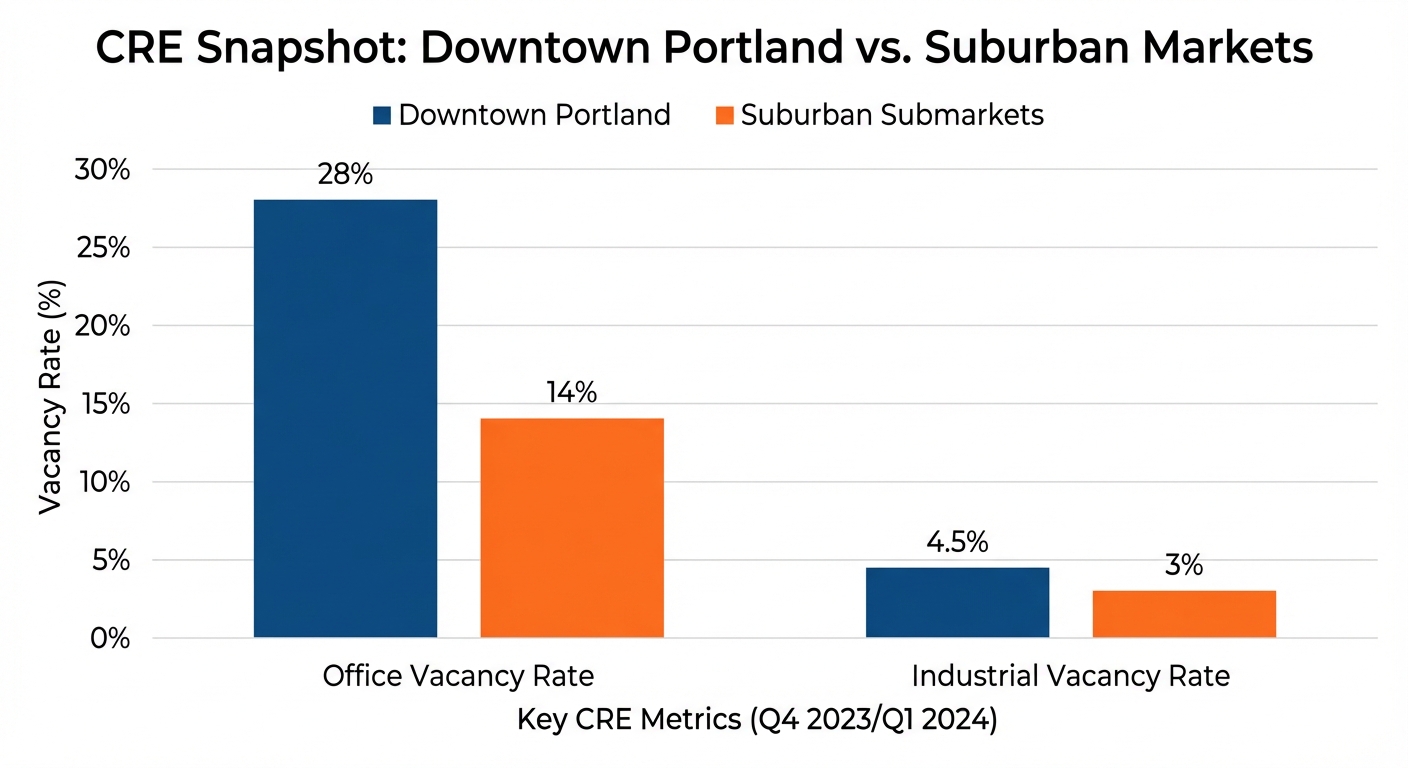
The commercial real estate landscape in Portland, Oregon is experiencing a profound transformation—one that savvy investors can no longer afford to ignore. While downtown Portland grapples with vacancy rates exceeding 28% and structural challenges from remote work trends, the surrounding suburban markets of Hillsboro, Wilsonville, and Gresham are emerging as powerhouse investment destinations. This shift isn’t temporary. It’s driven by powerful, interconnected forces: the federal government’s $8.5 billion CHIPS Act investment in Intel’s Oregon operations, sustained population migration to Washington and Clackamas counties, and the explosive growth of e-commerce logistics infrastructure. Industrial vacancy rates in these suburbs have plummeted below 4%—among the tightest in the nation—while rental growth accelerates. For business-focused investors seeking resilient, growth-oriented opportunities, Portland’s suburbs offer a compelling value proposition across multiple asset classes: advanced manufacturing facilities, last-mile distribution centers, medical office buildings, and necessity-based retail. This article examines the economic fundamentals, demographic trends, and specific submarket dynamics that are reshaping where—and how—commercial real estate investors should deploy capital in the Portland metropolitan area.
Three Powerful Trends Reshaping Portland’s CRE Landscape
Understanding the broader economic and demographic context is essential for identifying sustainable investment opportunities. Three interconnected trends are fundamentally altering the region’s commercial real estate market.
Population Migration to the Suburbs
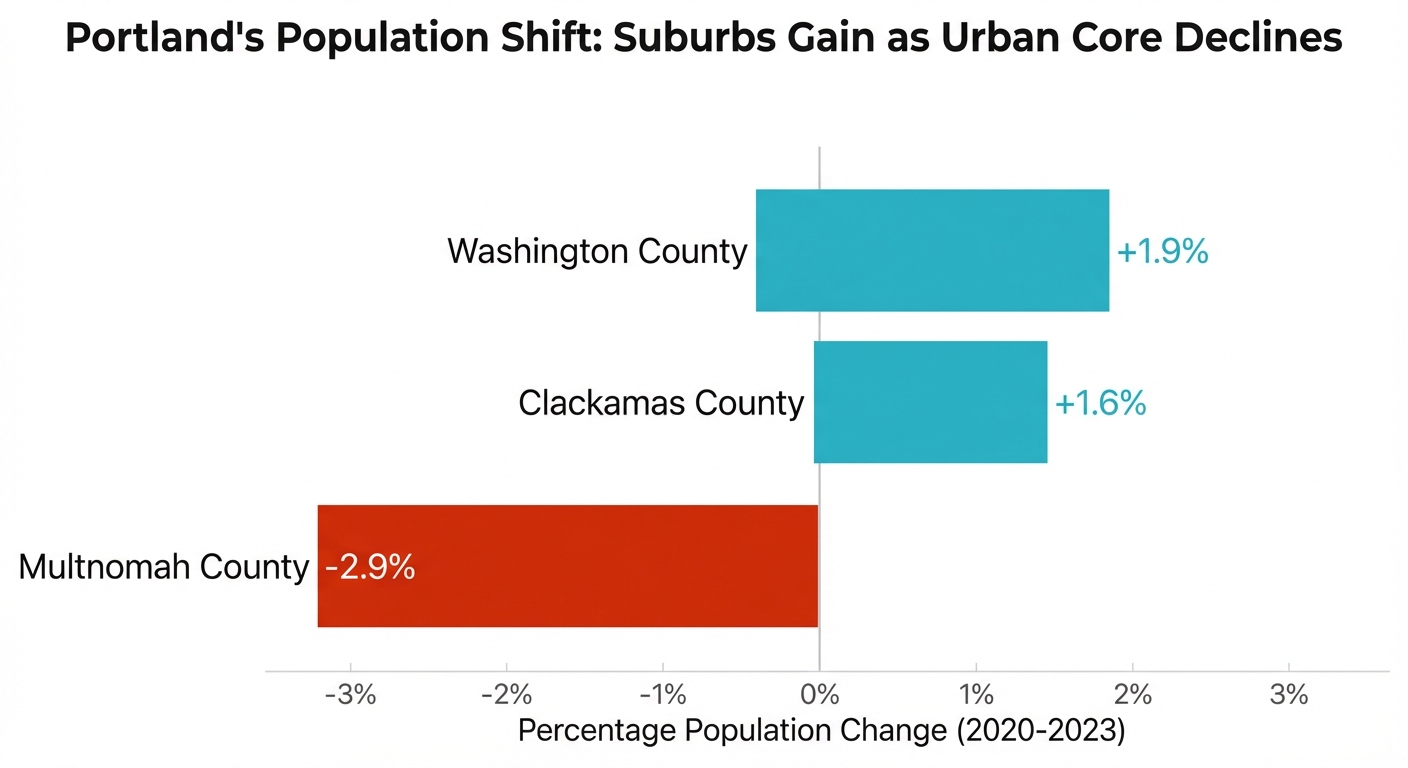
The numbers tell a compelling story. Between 2020 and 2023, Washington County’s population grew 1.9% and Clackamas County expanded by 1.6%, while Multnomah County—containing Portland’s urban core—declined by 2.9%. This isn’t a momentary blip; Portland State University projects this trend will accelerate through 2045, with suburban counties significantly outpacing the urban center.
This residential growth doesn’t exist in isolation. It generates sustained demand for grocery-anchored retail centers, urgent care clinics, professional services, and the entire ecosystem of businesses that serve growing communities. For investors, population growth translates directly into tenant demand and rental rate stability.
The “Silicon Forest” and Federal Investment
Oregon’s technology and advanced manufacturing sectors provide thousands of high-wage jobs concentrated in the western suburbs. This “Silicon Forest” has been a regional strength for decades, but recent federal policy has transformed it from a competitive advantage into a structural growth driver. The CHIPS and Science Act represents a watershed moment for the Portland suburbs. The U.S. Department of Commerce announced a preliminary agreement to provide Intel with up to $8.5 billion in direct funding, with its Oregon operations playing a central role in leading-edge research and development. This positions Hillsboro—Intel’s largest global site—as a cornerstone of America’s semiconductor independence strategy. The economic multiplier effect cannot be overstated. Every high-wage technology job supports an ecosystem of suppliers, logistics providers, construction firms, and professional services—all requiring commercial space. Major facilities for Lam Research and Applied Materials further concentrate this specialized industrial cluster, creating sustained demand for industrial flex space, research laboratories, and supporting office infrastructure.
Post-Pandemic Workplace Evolution
The hybrid work revolution has fundamentally rewritten the rules of office demand. Large downtown office footprints—once the gold standard for corporate prestige—now represent costly liabilities for many companies. The result: downtown Portland’s office vacancy rate exceeds 28%, while suburban office markets demonstrate remarkable resilience. Companies increasingly favor “hub-and-spoke” models with satellite offices offering employees shorter commutes, free parking, and proximity to residential communities. This structural shift supports demand for Class A suburban office space in locations like Hillsboro’s Orenco Station and Lake Oswego’s Kruse Way corridor—properties offering modern amenities, outdoor access, and the flexibility today’s workforce demands. Infrastructure improvements amplify these advantages. Highway expansions along I-5 and I-205 reduce commute friction, while TriMet’s MAX light rail extensions enhance suburban connectivity without requiring employees to navigate downtown congestion. For investors, these transportation investments reduce location risk and broaden the pool of potential tenants.
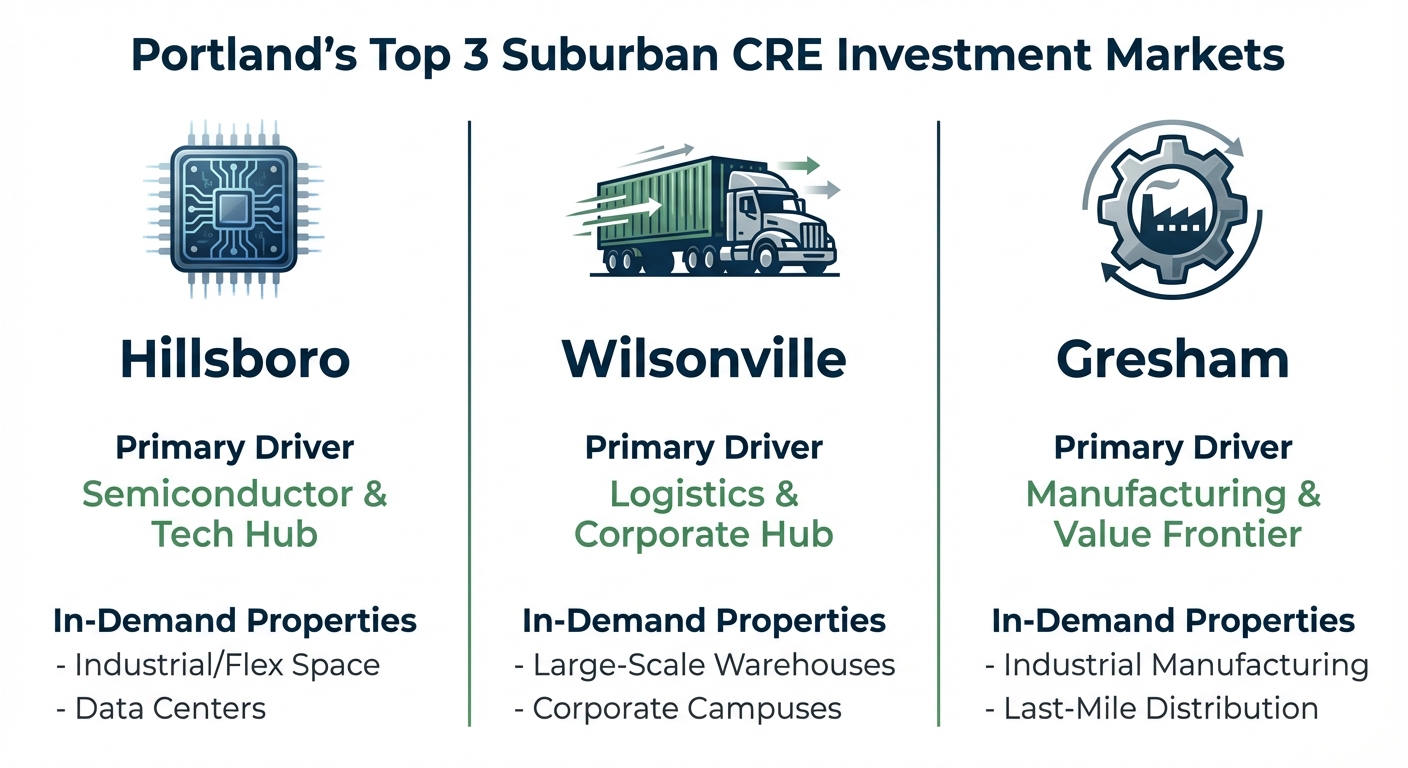
Inside Hillsboro: Where Semiconductor Innovation Meets Commercial Real Estate Opportunity
Hillsboro represents the epicenter of Oregon’s technology sector and offers investors exposure to one of the most strategically important industrial markets in North America.
The Intel Effect and CHIPS Act Impact
Intel operates its largest global research and manufacturing site in Hillsboro, anchoring an ecosystem of semiconductor suppliers, equipment manufacturers, and specialized service providers. This concentration creates what economists call “agglomeration benefits”—the competitive advantages that emerge when related businesses cluster together. The CHIPS Act funding will further entrench Hillsboro’s role as a global R&D leader. Billions in direct investment create thousands of construction jobs, permanent high-wage positions, and indirect employment across the supply chain. For commercial real estate investors, this federal commitment provides unusual visibility into long-term demand: these facilities represent decade-long investments that cannot be easily relocated. Major operations for Lam Research and Applied Materials—companies providing critical manufacturing equipment to the semiconductor industry—create a dense cluster of high-value manufacturing. This concentration generates sustained demand for specialized industrial properties: clean rooms, research laboratories, advanced manufacturing facilities, and the warehouse space required to support complex supply chains.
In-Demand Property Types
Industrial and Flex Space dominates Hillsboro’s investment opportunity set. The convergence of manufacturing, research, and logistics creates exceptional demand for versatile properties that can accommodate everything from prototype development to light assembly to warehouse distribution. These flex facilities command premium rents due to their specialized infrastructure requirements and limited supply. Data Centers represent a growing opportunity as cloud computing and artificial intelligence drive exponential data storage needs. Hillsboro’s favorable power infrastructure, fiber connectivity, and relatively cool climate position it as a prime data center location. The presence of existing facilities creates a “data center alley” effect, where telecommunications providers concentrate infrastructure investment. Class A Suburban Office serves the professional ecosystem surrounding advanced manufacturing. Legal firms specializing in intellectual property, accounting practices serving multinational corporations, engineering consultancies, and management teams all require modern office environments. These tenants seek proximity to manufacturing facilities, ample parking, and the amenities that attract and retain specialized talent.
Development-Friendly Zoning Framework
The City of Hillsboro’s comprehensive plan explicitly prioritizes preservation and expansion of industrial land, particularly in northern districts designated for advanced manufacturing. This policy certainty reduces entitlement risk—a critical consideration in Oregon’s complex land-use system. Active economic development support includes infrastructure investment in utilities, roads, and telecommunications. The city has streamlined permitting processes for industrial projects, recognizing that speed-to-market matters for technology companies facing global competition. Strategic land banking ensures long-term industrial capacity, preventing the supply constraints that have hampered growth in other West Coast technology hubs. The Orenco Station development demonstrates suburban markets can support high-density, walkable, mixed-use environments commanding premium rents. Developed around a TriMet MAX station, this transit-oriented community integrated residential, retail, and office space in a pedestrian-friendly design. The result: rental premiums 15-20% above comparable suburban locations and sustained tenant demand through multiple economic cycles.
Wilsonville’s Geographic Advantage: Where I-5 Meets Industrial Demand
Positioned at the intersection of Interstate 5 and I-205, Wilsonville has emerged as the Portland region’s premier logistics and distribution center—a classification that translates directly into commercial real estate demand.
Unmatched Logistics Infrastructure
Geography is destiny in logistics, and Wilsonville’s location is exceptional. The convergence of I-5 (the West Coast’s primary north-south freight corridor) and I-205 (Portland’s eastern bypass) provides unmatched connectivity. Distribution centers here can reach the Port of Portland, PDX Airport, and major population centers throughout the Pacific Northwest within minutes. This accessibility attracts major distribution operations. Costco operates a massive distribution center serving the Pacific Northwest. Swire Coca-Cola’s regional bottling and distribution facility supplies beverage products across Oregon and Southwest Washington. These anchor tenants demonstrate Wilsonville’s value proposition: efficient access to suppliers, customers, and transportation infrastructure. Direct connectivity to both north-south and east-west freight corridors reduces transportation costs—a critical factor for logistics-intensive businesses. Companies can consolidate regional distribution in Wilsonville rather than maintaining multiple facilities, generating operational efficiencies that support higher rents for well-located industrial properties.
High-Demand Asset Classes
Large-Scale Industrial Warehouses represent Wilsonville’s core investment opportunity. Modern distribution centers require specific characteristics: clear heights exceeding 32 feet for high-density storage, extensive dock doors for simultaneous truck loading, and column spacing accommodating automated material handling systems. Properties meeting these specifications command significant rental premiums and experience virtually zero vacancy. E-commerce growth drives insatiable demand for these facilities. Third-party logistics providers (3PLs) require massive warehouse footprints to serve retailers lacking internal distribution capabilities. The surge in direct-to-consumer shipping has fundamentally altered space requirements—companies now need 3-4 times the square footage per dollar of sales compared to traditional retail distribution models. Corporate Campus Office represents Wilsonville’s second major asset class. Companies like Flir Systems (now Teledyne) and Mentor Graphics (acquired by Siemens) maintain significant operations here. The city’s combination of accessibility, quality of life, and competitive operating costs makes it attractive for corporate relocations and expansions. These headquarters facilities support substantial office employment while maintaining proximity to research, development, and manufacturing operations.
Future Development Pipeline
The Basalt Creek and Coffee Creek planning areas represent over 1,000 acres master-planned for industrial, employment, and commercial development. This ensures a sustained pipeline of developable land—a critical factor preventing the supply constraints that drive acquisition costs to unsustainable levels in landlocked markets. Mixed-use planning allows integration of office, retail, and residential components, creating complete employment districts rather than isolated industrial parks. This approach attracts a broader range of employers and supports higher-quality development. For investors, master-planned areas reduce uncertainty about adjacent development and provide confidence in long-term value appreciation. With industrial vacancy rates at 2.5-3.5% and sustained demand across multiple sectors, rental rates have experienced aggressive year-over-year growth. Limited new supply keeps upward pressure on rates, offering strong returns for landlords who secured properties before the current market tightness.
Gresham: Where Affordability Meets Industrial Opportunity in East Portland
As Oregon’s fourth-largest city, Gresham offers investors a compelling value proposition: lower land costs, a growing workforce, excellent transportation access, and proactive economic development incentives.
The Affordability Advantage
Real estate fundamentals favor Gresham for value-oriented investors. Land acquisition costs run 30-40% below comparable western suburbs, allowing for higher development yields on industrial and warehouse projects. This cost advantage attracts manufacturers and distributors seeking to control occupancy expenses while maintaining Portland metro market access. The growing residential population creates consistent demand for service-oriented commercial properties. As households relocate from Portland’s urban core to more affordable suburban locations, they bring demand for grocery stores, medical services, restaurants, and retail—creating stable, necessity-based tenant demand regardless of economic cycles. Direct access to Interstate 84 provides critical east-west logistics connectivity. This highway corridor links Portland to the Columbia River Gorge, the Inland Northwest, and ultimately Interstate 90—making Gresham the natural logistics gateway for freight destined for Idaho, Montana, and Eastern Washington markets.
Core Property Type Opportunities
Industrial Manufacturing forms the foundation of Gresham’s economy. Facilities for food processing (taking advantage of Oregon’s agricultural production), metals fabrication, and aerospace component manufacturing provide stable, long-term tenancy. The Gresham Vista Business Park exemplifies this sector, housing diverse manufacturing and distribution operations in a master-planned industrial environment. Last-Mile Distribution represents Gresham’s highest-growth opportunity. With over 110,000 residents and continuing population growth, the city serves as a critical hub for “last-mile” delivery operations serving the entire east Portland metro area. Amazon, FedEx, and regional carriers require distribution facilities positioned close to dense residential populations—exactly what Gresham provides. Necessity-Based Retail benefits from expanding residential density. Grocery-anchored shopping centers, quick-service restaurants, and medical service providers experience sustained demand as household formation increases. These properties offer stable cash flows with limited e-commerce disruption risk—characteristics that appeal to income-focused investors.
Economic Development Support
The City of Gresham’s Enterprise Zone program offers property tax abatements to attract new industrial and manufacturing businesses. These incentives reduce the initial cost burden of investment, improving project pro formas and enhancing returns for early-stage developments. Active city support extends beyond tax incentives. Streamlined permitting processes reduce project timelines, and infrastructure investments in utilities and transportation access demonstrate municipal commitment to industrial growth. For investors, this collaborative approach reduces regulatory risk and provides confidence in long-term political support for business-friendly policies. Industrial vacancy rates below 4% across the Portland metro area demonstrate a structural supply-demand imbalance benefiting all suburban industrial markets. This scarcity drives rental rate appreciation and provides landlords with substantial pricing power in lease negotiations.
Critical Due Diligence: Understanding Oregon’s Land Use System and Investment Structures
Oregon’s distinctive regulatory environment creates both challenges and competitive advantages for informed investors. Understanding the state’s land-use framework is essential for successful deal execution.
The Urban Growth Boundary (UGB) System
Every Oregon city operates under state-mandated comprehensive plans with designated Urban Growth Boundaries separating developable urban land from protected rural areas. This system, established in 1973, represents one of the nation’s most restrictive land-use frameworks. Impact on investment: The UGB artificially constrains land supply, driving up land values and creating high barriers to entry. For existing property owners, this supply restriction provides long-term asset value protection by preventing uncontrolled sprawl that could undermine property values. Concentrated development where infrastructure exists improves project feasibility—utilities, roads, and services already exist rather than requiring costly extensions. However, the UGB system creates entitlement complexity. Expanding the boundary requires extensive public process, environmental review, and political consensus—a process measured in years rather than months. Investors must carefully assess whether target properties lie within the UGB and whether adequate infrastructure capacity exists to support proposed development.
Essential Due Diligence Requirements
Successful investment in Oregon requires thorough analysis of multiple regulatory layers: Local zoning ordinances dictate permitted uses, density limits, setback requirements, and design standards. These regulations vary substantially between jurisdictions—what’s permitted in Hillsboro may be prohibited in Gresham. Comprehensive plans provide long-term guidance on community development priorities. Hillsboro’s 2035 Community Plan explicitly prioritizes industrial land preservation, providing confidence that industrial zoning won’t be converted to residential use. Investors should review comprehensive plans early in due diligence to ensure alignment between investment strategy and municipal priorities. Infrastructure capacity assessment must address sewer, water, electrical service, and transportation access. Oregon cities charge system development charges (SDCs) to fund infrastructure expansion—costs that can range from $50,000 to over $200,000 per acre depending on location and use. These charges directly impact project feasibility and must be incorporated into financial modeling. Entitlement timelines in Oregon can be lengthy and complex. Land-use decisions are subject to appeal at multiple levels, and citizen involvement is extensive. Budget additional time and capital for the entitlement process—successful projects typically require 12-24 months from initial application to building permit issuance. Partnering with local commercial real estate professionals who understand Oregon’s regulatory nuances is critical. Experienced local advisors can identify potential obstacles early, recommend appropriate project structuring, and accelerate the approval process through established relationships with planning officials.
Opportunity Zone Advantages
Several suburban Portland areas are designated federal Opportunity Zones, offering significant tax advantages for long-term investors. These zones, created under the 2017 Tax Cuts and Jobs Act, provide three key benefits: Capital gains deferral allows investors to defer taxes on gains reinvested in Opportunity Zone properties until December 2026 or when the investment is sold, whichever comes first. Basis step-up reduces the deferred capital gain by 10% if the Opportunity Zone investment is held for five years, creating a permanent tax reduction. Capital gains elimination on Opportunity Zone investment appreciation if held for ten years—potentially the most valuable benefit for long-term commercial real estate investors. Strategic deployment of Opportunity Zone capital can substantially enhance after-tax returns, particularly for high-net-worth investors facing large capital gains from previous investment exits.
The Importance of Comprehensive Plans
Each city’s comprehensive plan provides critical insight into long-term development priorities. These documents, updated every 5-7 years, reveal where municipalities expect future growth, what land uses they prioritize, and where infrastructure investments will concentrate. Hillsboro’s comprehensive plan prioritizes industrial land preservation in northern districts, signaling long-term commitment to advanced manufacturing. Wilsonville’s plan emphasizes employment growth and strategic land use at interstate interchanges. Gresham focuses on neighborhood commercial development supporting its expanding residential base. Review comprehensive plans early in the due diligence process. Properties aligned with stated municipal priorities face fewer regulatory obstacles, faster entitlement, and greater likelihood of supportive infrastructure investment. Conversely, properties inconsistent with comprehensive plan objectives face prolonged approval processes and potential denial.
Where to Deploy Capital: The Highest-Conviction Property Types
Not all commercial real estate asset classes offer equal opportunity in Portland’s suburban markets. Strategic investors should prioritize sectors with structural demand tailwinds and limited supply.
Tier 1 Opportunity: Industrial and Logistics
Portland metro industrial vacancy remained below 4% in early 2024—among the tightest markets nationally. This scarcity reflects fundamental supply-demand imbalance: e-commerce growth, semiconductor manufacturing expansion, and logistics network optimization all require massive industrial space, yet new construction has lagged demand for over five years. Priority assets include modern distribution centers with clear heights exceeding 32 feet, extensive dock configurations, and proximity to interstate highways. Cold storage facilities supporting food distribution command particular premiums due to specialized infrastructure requirements and limited supply. Last-mile delivery hubs—smaller facilities (30,000-100,000 square feet) positioned near dense residential populations—experience virtually zero vacancy and aggressive rental rate growth. The rental rate trajectory remains strongly positive. With sub-4% vacancy and persistent demand across multiple sectors, landlords possess substantial pricing power. Year-over-year rent growth has exceeded 8% in prime logistics corridors, and this trend shows no signs of moderating as long as supply remains constrained.
Tier 1 Opportunity: Flex Space
The convergence of office, warehouse, and light manufacturing needs creates exceptional versatility in flex properties. Technology startups require spaces accommodating both administrative functions and prototype development. Research labs need office components plus specialized infrastructure. Life science companies seek facilities integrating research, laboratory, and office functions in proximity. This diverse tenant demand creates exceptional stability—if one sector softens, others provide backfill demand. Flex properties in technology corridors like Hillsboro command premium rents due to limited supply and strong competitive positioning. The build-out flexibility allows landlords to customize spaces for specific tenant requirements, supporting higher rental rates and longer lease terms.
Tier 2 Opportunity: Medical Office Buildings (MOBs)
Aging demographics drive sustained demand for outpatient medical facilities. Baby Boomers entering peak healthcare consumption years generate growing need for specialty clinics, ambulatory surgery centers, and diagnostic facilities. Suburban population growth places these patients increasingly distant from urban hospital campuses, creating demand for distributed medical facilities. Proximity to hospital campuses and residential clusters is critical for success. Medical tenants seek locations offering convenient patient access, adequate parking, and proximity to referring physicians. Properties meeting these criteria experience stable, long-term occupancy with creditworthy institutional tenants. Necessity-based healthcare services provide recession-resistant cash flows. Unlike discretionary retail or Class B office, medical office demand remains stable through economic downturns. This defensive characteristic appeals to risk-averse investors prioritizing income stability over aggressive appreciation.
Tier 2 Opportunity: Necessity-Based Retail
While traditional retail faces structural challenges, grocery-anchored centers demonstrate remarkable stability. High-performing grocers like Trader Joe’s, New Seasons, and Whole Foods generate consistent foot traffic that benefits adjacent tenants. Quick-service restaurants and pharmacies remain largely insulated from e-commerce disruption—consumers still prefer immediate food service and prescription fulfillment. Focus on well-located assets in growing residential corridors. Centers positioned at major intersections with strong demographics (household income exceeding $75,000, population density supporting 50,000+ square feet of retail) experience sustained demand and stable occupancy. Avoid secondary locations dependent on discretionary retail categories vulnerable to online competition.
Avoid or Approach Cautiously: Traditional Office
Downtown Portland office vacancy exceeds 28%, and suburban office markets show mixed performance. The structural shift toward hybrid work has fundamentally reduced space requirements for many companies. Firms that previously maintained 200 square feet per employee now target 150 or less, incorporating hoteling and flexible workstation strategies.
Only consider Class A suburban office with strong amenities, parking, and proximity to residential growth areas. Trophy buildings in Hillsboro’s Orenco Station, Lake Oswego’s Kruse Way, or Wilsonville’s Coffee Creek offer viable opportunities—but require thorough tenant credit analysis and long-term lease structures to mitigate risk. Tenant credit quality and long-term lease structures are critical for risk mitigation. Seek creditworthy tenants (investment-grade ratings or substantial financial resources) and minimum five-year lease terms with built-in rent escalations. These protections reduce income volatility and provide time for market conditions to stabilize.
The Transformative Power of Industrial Investment: Learning from Meta’s Oregon Data Center
While not located in a Portland suburb, Meta’s massive data center investment in Prineville, Oregon provides a powerful blueprint for understanding the economic impact of large-scale industrial development.
Project Scale and Economic Impact
Since 2010, Meta has invested over $2 billion in its Prineville data center campus, now spanning more than 5 million square feet. This single project transformed Crook County’s economy, creating hundreds of high-paying operational positions and thousands of temporary construction jobs during successive expansion phases. The economic multiplier extends far beyond direct employment. Data centers require sophisticated mechanical systems, specialized electrical infrastructure, and continuous maintenance—generating sustained demand for engineering firms, construction contractors, and equipment suppliers. Local retail and hospitality sectors benefit from increased workforce spending, while housing demand rises as employees relocate to the area.
The Catalytic “Halo Effect”
Meta’s commitment established Prineville as a data center hub, attracting additional tech giants. Apple invested over $1 billion in its own Prineville data center campus. Google followed with a similar facility in The Dalles, Oregon. This concentration created a “data center alley” across Central Oregon—transforming a region historically dependent on timber and agriculture into a technology infrastructure center. Generated sustained demand for industrial suppliers, construction services, and local retail/hospitality businesses. Each new project creates temporary construction employment, permanent operational jobs, and indirect economic activity across the entire regional economy. Property values and tax revenues increased substantially throughout the region, funding improved schools, infrastructure, and public services.
Parallels to Portland Suburbs
The CHIPS Act investment in Hillsboro’s semiconductor industry represents a similar catalytic moment. Intel’s $8.5 billion commitment will generate thousands of direct jobs, tens of thousands of indirect positions, and establish Oregon as a global center for semiconductor research and development. Each major industrial expansion creates multiplier effects across the entire commercial real estate ecosystem. Advanced manufacturing requires specialized industrial facilities. Suppliers need warehouse and distribution space. Professional services supporting the industry require office locations. Workers need housing, retail, and entertainment options—generating demand across all property types. Investors positioned near these anchor developments benefit from long-term appreciation and sustained tenant demand. Properties within 5-10 miles of major industrial investments experience above-market rent growth, faster lease-up of new construction, and greater resilience during economic downturns due to employment stability.
Key Takeaways
The commercial real estate opportunity in Portland’s suburban markets is not speculative—it’s supported by powerful, long-term fundamentals that will define the region’s economic landscape for decades to come. The convergence of federal semiconductor investment, sustained population migration, and the structural evolution of workplace patterns has positioned Hillsboro, Wilsonville, and Gresham as the epicenter of commercial real estate growth in the Pacific Northwest. While downtown Portland faces a challenging reset, the suburbs benefit from critically low industrial vacancy rates, robust infrastructure development, and a diverse, growing economic base anchored by technology, advanced manufacturing, and logistics. For investors willing to navigate Oregon’s complex land-use system and conduct thorough submarket analysis, the opportunity set is compelling across multiple asset classes. The data is clear: industrial and flex space offer the highest conviction opportunities, supported by sub-4% vacancy rates and accelerating rental growth. Medical office buildings and necessity-based retail provide stable, recession-resistant cash flows in growing residential corridors. And for those with longer investment horizons, the development pipeline in master-planned areas like Wilsonville’s Basalt Creek represents generational wealth-building opportunities. The question isn’t whether Portland’s suburbs will continue to outperform—the structural drivers ensure they will. The question is whether investors will recognize this shift before these markets become fully priced. For those who act strategically and partner with local expertise, Portland’s suburban commercial real estate markets offer a rare combination of growth, stability, and long-term value creation.
Ready to Explore Portland’s Suburban CRE Markets?
For investors ready to explore these opportunities, GW Hartley IV provides specialized expertise in the Portland metropolitan commercial real estate market. With deep knowledge of Oregon’s regulatory environment and established relationships across the region’s suburban markets, we help investors identify, evaluate, and execute on opportunities aligned with their strategic objectives.
References:
- U.S. Census Bureau. (2024). Annual Estimates of the Resident Population for Counties in Oregon: April 1, 2020 to July 1, 2023
- Portland State University Population Research Center. (2022). Oregon Population Forecast Program: Clackamas, Multnomah, and Washington Counties
- Oregon Employment Department. (2021). Oregon Employment Projections by Industry and Occupation, 2020-2030
- The White House. (2024). Biden-Harris Administration Announces Preliminary Terms with Intel to Onshore U.S. Chip Manufacturing Leadership
- TriMet. (2024). Projects & Initiatives
- Intel Corporation. (2023). Intel in Oregon Fact Sheet
- City of Hillsboro. (2023). Hillsboro 2035 Community Plan
- City of Wilsonville. (2023). Basalt Creek, Coffee Creek, and Frog Pond
- City of Gresham. (2024). Enterprise Zone Program
- City of Portland. (2024). Office Market Analysis and Re-occupancy Strategy
- Greater Portland Inc. (2024). Greater Portland Key Industries & Market Trends
- Oregon Department of Land Conservation and Development. (2024). Oregon’s Statewide Planning Goals
- Business Oregon. (2024). Oregon Opportunity Zones
- Meta. (2023). Our Prineville Data Center
- Congress for the New Urbanism. (2009). Orenco Station: A new, old-fashioned neighborhood