Table of Contents
- The Big Picture: Market Trends, Demographics, and What Buyers Need to Know
- The Pearl District: Portland’s Premier Walkable, Upscale Urban Experience
- Classic Portland Charm: Laurelhurst and Sellwood-Moreland
- Beaverton and Hillsboro: Where Affordability, Schools, and Tech Jobs Converge
- How to Choose: Three Buyer Personas and Their Ideal Neighborhoods
- Final Thoughts
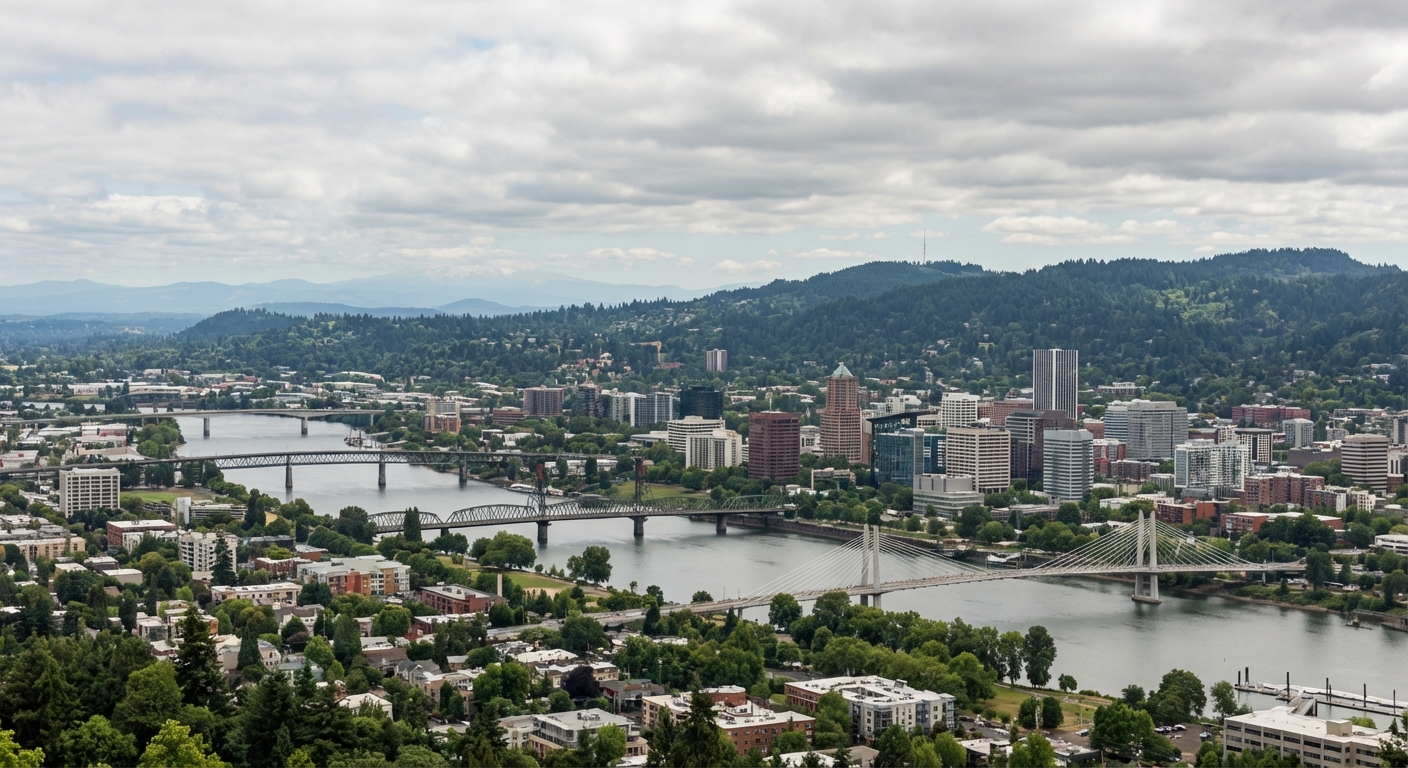
Relocating to Portland, Oregon? The city’s reputation for coffee culture, microbreweries, and lush greenery is well-earned—but what about the actual neighborhoods where you’ll live, commute, and raise a family? The Portland metro area is far more nuanced than its stereotypes suggest. With a population exceeding 2.5 million, the region spans diverse urban cores, historic residential enclaves, and sprawling suburban tech hubs. Each offers a distinct lifestyle, from the walkable luxury of the Pearl District to the family-friendly affordability of Hillsboro. Yet, many prospective buyers are overwhelmed by incomplete or overly subjective information. This guide cuts through the noise with data-driven insights on five key locations: the Pearl District, Laurelhurst, Sellwood-Moreland, Beaverton, and Hillsboro. We’ll examine housing costs, commute realities, school quality, property taxes, and lifestyle trade-offs to help you make an informed decision. Whether you’re a tech professional eyeing Intel’s Hillsboro campus, a young family prioritizing top-tier schools, or an urban enthusiast seeking a car-free lifestyle, this guide will help you match your priorities to the right neighborhood.
The Big Picture: Market Trends, Demographics, and What Buyers Need to Know
Before diving into specific neighborhoods, it’s essential to understand the broader forces shaping Portland’s real estate landscape—population growth, housing prices, and regional planning. Population Growth & Diversity: The Portland-Vancouver-Hillsboro MSA has grown to over 2.5 million residents, driven by a strong job market in tech, healthcare, and creative industries. The region boasts above-average educational attainment, with 44.5% of adults holding bachelor’s degrees. This educated workforce has helped establish Portland as both a cultural hub and an economic powerhouse, particularly in the technology sector often referred to as the “Silicon Forest.” Housing Market Reality: The median home price in the metro area is approximately $530,000 as of early 2024, reflecting a decade of constrained supply and high demand. The S&P CoreLogic Case-Shiller Index shows dramatic post-2020 appreciation, though growth has since moderated. This fundamental shift in baseline affordability makes the trade-offs between city and suburban living more critical than ever—balancing cost against commute times and desired amenities requires careful consideration.
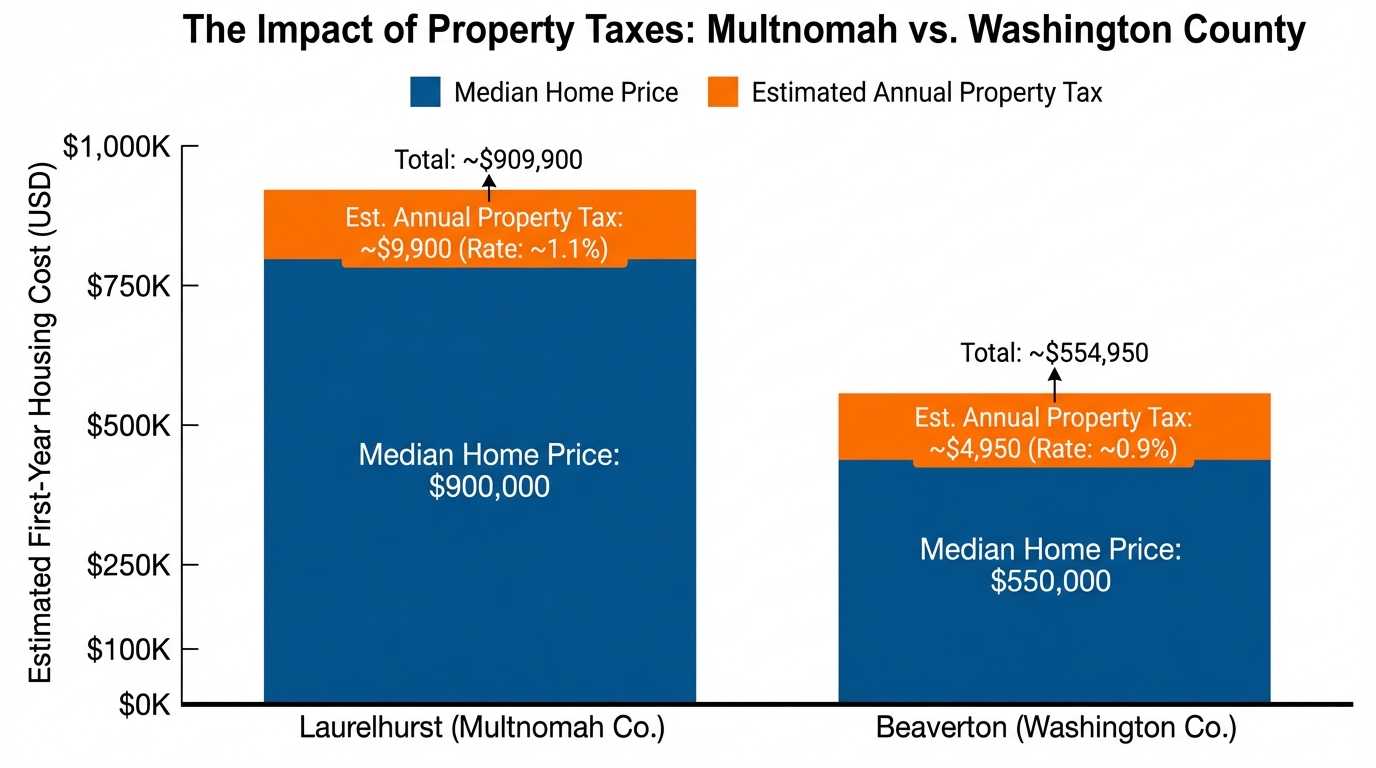
One often-overlooked aspect of homeownership costs? Property taxes. As the chart above illustrates, the difference between Multnomah County (which includes Portland’s urban neighborhoods) and Washington County (home to Beaverton and Hillsboro) can be significant—potentially thousands of dollars annually on similarly priced homes. Regional Planning & Growth Management: Metro’s 2040 Growth Concept prioritizes urban density while protecting farmland, influencing where new development occurs and how neighborhoods evolve. This approach has helped Portland maintain its green spaces and natural beauty while accommodating growth, but it has also contributed to housing supply constraints in the urban core. Commute & Congestion: Portland ranks 14th for worst U.S. traffic congestion, with drivers losing an average of 42 hours annually to delays. The average commute is 27.5 minutes, but this varies drastically by location. Major corridors like I-5, I-84, and US-26 experience significant peak-hour congestion. Fortunately, TriMet’s MAX Light Rail and extensive bus network provide robust alternatives for those willing to utilize public transit.
The Pearl District: Portland’s Premier Walkable, Upscale Urban Experience
For those who want a car-free, culturally rich lifestyle with immediate access to downtown, the Pearl District is unmatched—but it comes with trade-offs in cost and space. Once an industrial area of warehouses and railyards, the Pearl District has transformed since the 1990s into Portland’s most upscale urban neighborhood. Today, it stands as a model of urban redevelopment, featuring loft apartments, art galleries, and some of the city’s finest dining establishments.
Housing & Affordability
The Pearl consists almost exclusively of condos and apartments in mid-rise and high-rise buildings. Median condo prices hover around $650,000, with high monthly HOA fees standard. Per-square-foot costs are among the region’s highest, but buyers are paying for location and lifestyle as much as physical space. Expect modern finishes, amenities like fitness centers and rooftop terraces, and the convenience of ground-floor retail.
Walkability & Transit
With a Walk Score of 97 (“Walker’s Paradise”), Transit Score of 91, and Bike Score of 96, the Pearl District epitomizes urban convenience. The Portland Streetcar glides through the neighborhood, while multiple bus lines provide connections throughout the metro area. For those working downtown, commutes are often 10-15 minutes on foot or transit—many residents walk to their offices while enjoying morning coffee along the way.
Demographics & Lifestyle
The median age hovers around 42, with a high percentage of single professionals and couples without children. The neighborhood serves as the epicenter of Portland’s upscale dining scene, art galleries (including the legendary Powell’s City of Books), and boutique shopping. Weekend mornings might find residents brunching at trendy cafes, browsing the Saturday Market, or strolling through curated urban parks like Jamison Square and Tanner Springs Park.
Schools
Zoned to Portland Public Schools, the Pearl District’s demographics mean K-12 education is less of a focal point than in other neighborhoods. Families living here often opt for private or alternative schools. The concentration of working professionals without school-age children reflects in the neighborhood’s cultural priorities.
Trade-offs
High density means urban noise and less privacy—street sounds, neighboring units, and the general buzz of city life are constant companions. Green space is limited to small, curated parks rather than expansive natural areas. The Pearl is decidedly not ideal for families seeking yards, quiet residential streets, or that classic Portland house with a front porch and rose garden.
Classic Portland Charm: Laurelhurst and Sellwood-Moreland Offer Historic Elegance and “Urban Village” Appeal
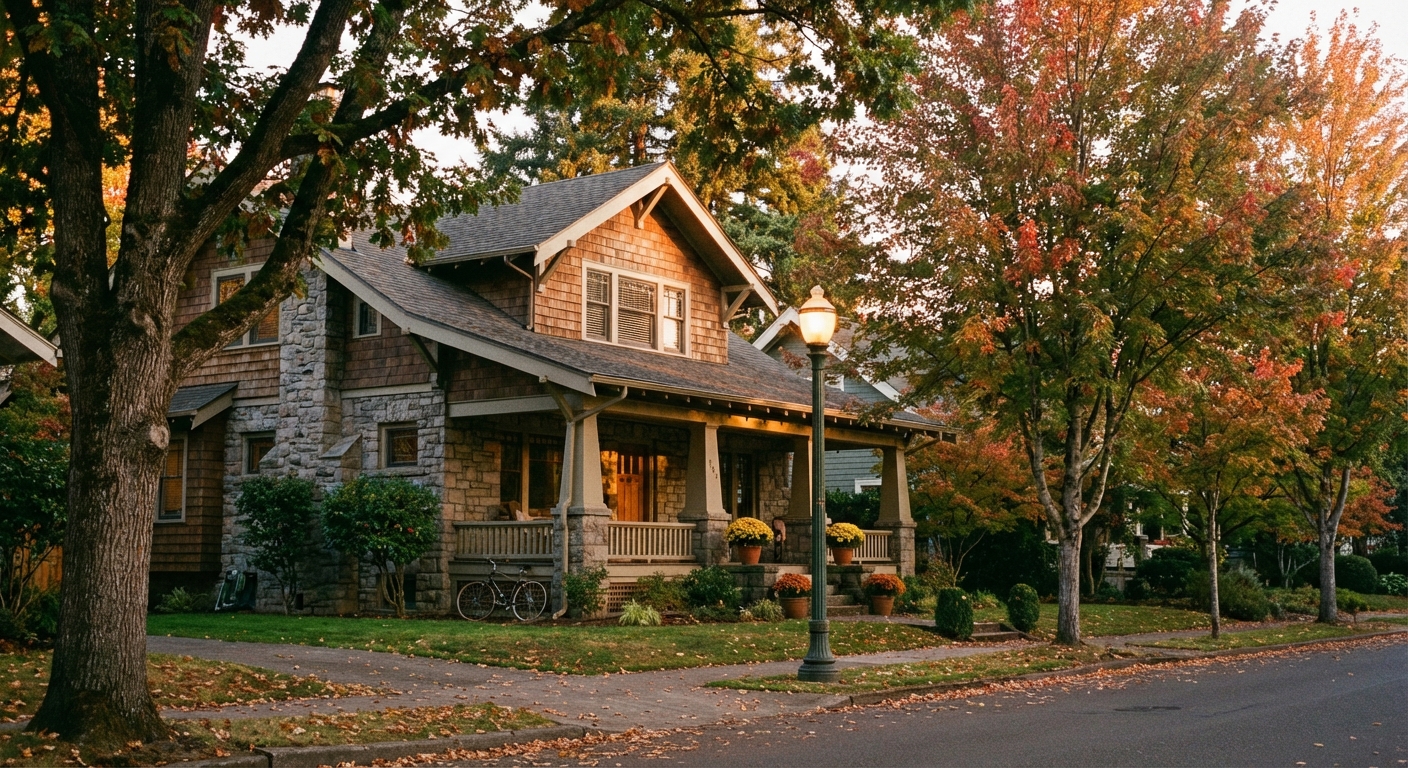
These two Southeast Portland neighborhoods represent distinct versions of established city living—one steeped in architectural history, the other offering a tight-knit, small-town feel within the city.
Laurelhurst: Historic Architectural Treasure
Laurelhurst is a historic, primarily residential neighborhood celebrated for its elegant early-20th-century homes and the iconic Laurelhurst Park. Designed by the Olmsted Brothers—the same firm behind New York’s Central Park—and listed on the National Register of Historic Places, this neighborhood embodies Portland’s commitment to preserving architectural heritage. Housing & Character: Single-family homes dominate, showcasing Craftsman, Tudor, and Colonial styles with meticulous period details. Median sale prices exceed $900,000, reflecting not just square footage but architectural integrity and historical significance. These aren’t cookie-cutter suburban homes—they’re pieces of Portland’s living history, often featuring original hardwood floors, built-in cabinetry, and stunning period craftsmanship. Walkability & Transit: With a Walk Score of 83 (“Very Walkable”), residents can accomplish most errands on foot, especially near commercial corridors like E Burnside and SE Stark. Multiple bus lines connect to downtown Portland, making car-free living viable for many residents. The neighborhood strikes that perfect balance: walkable urban convenience with a residential, tree-lined tranquility. Schools & Demographics: Zoned to Portland Public Schools with historically strong ratings, Laurelhurst attracts established professionals and families who value education. The area’s high educational attainment and above-average incomes reflect its appeal to successful professionals seeking an established neighborhood with character and community. Lifestyle: The 31-acre Laurelhurst Park, designed by the Olmsted Brothers, serves as the neighborhood’s centerpiece—a city landmark featuring a scenic pond, walking paths, tennis courts, and sports facilities. The park hosts community events and provides a gathering place for neighbors. Proximity to the vibrant Hawthorne and Belmont dining and shopping districts means residents enjoy easy access to Portland’s renowned food scene and independent retailers while maintaining a quiet, residential home base. Trade-offs: Historic homes can mean higher maintenance and renovation costs. Period plumbing, electrical systems, and structural elements may require specialist contractors and premium materials to maintain authenticity. Additionally, Multnomah County property taxes are substantial for high-value homes, adding meaningfully to the total cost of ownership.
Sellwood-Moreland: The Urban Village
Located in inner Southeast Portland along the Willamette River, Sellwood-Moreland functions as a self-contained “urban village” with a distinct main street, historic charm, and abundant recreational opportunities. Housing & Affordability: A diverse mix of Victorian homes, Craftsman bungalows, and newer infill developments creates visual interest and provides options at various price points. Generally more accessible than Laurelhurst, median prices hover around $700,000. This diversity means buyers can find everything from historic fixer-uppers to move-in-ready renovated gems and modern townhomes. Walkability & Transit: The commercial core along SE 13th Avenue gives the neighborhood a Walk Score of 85, creating that “main street” feel where residents know their local shopkeepers by name. The Sellwood Bridge provides downtown access, while multiple bus routes and the nearby MAX Orange Line station enhance transit connectivity. For cyclists and pedestrians, the Springwater Corridor offers a car-free route extending for miles along the river. Schools & Demographics: Served by Portland Public Schools with strong community involvement, Sellwood-Moreland attracts young families, long-time residents, and professionals. The neighborhood has that rare quality of feeling multigenerational—you’ll see elderly couples who’ve lived here for decades alongside young families pushing strollers down SE 13th Avenue. Lifestyle: Sellwood is known for its antique shops, the historic Moreland Theater (an independent cinema), local eateries emphasizing farm-to-table cuisine, and the beloved Oaks Amusement Park—a historic roller-skating rink and amusement park that’s been entertaining Portlanders since 1905. Sellwood Riverfront Park provides direct river access and stunning views, while the Springwater Corridor trail system connects cyclists and runners to miles of car-free paths. This neighborhood truly feels like a small town within the city—a place where you’ll run into neighbors at the coffee shop and everyone knows the best spots for weekend breakfast. Trade-offs: The Sellwood Bridge can bottleneck during commute times, and the neighborhood can feel somewhat geographically isolated from other parts of Portland. While charming, the commercial district is smaller and more limited than areas like Hawthorne or Alberta. Some residents find this insularity appealing—a quieter, more self-contained lifestyle—while others may feel disconnected from Portland’s broader cultural scene.
Beaverton and Hillsboro: Where Affordability, Schools, and Tech Jobs Converge
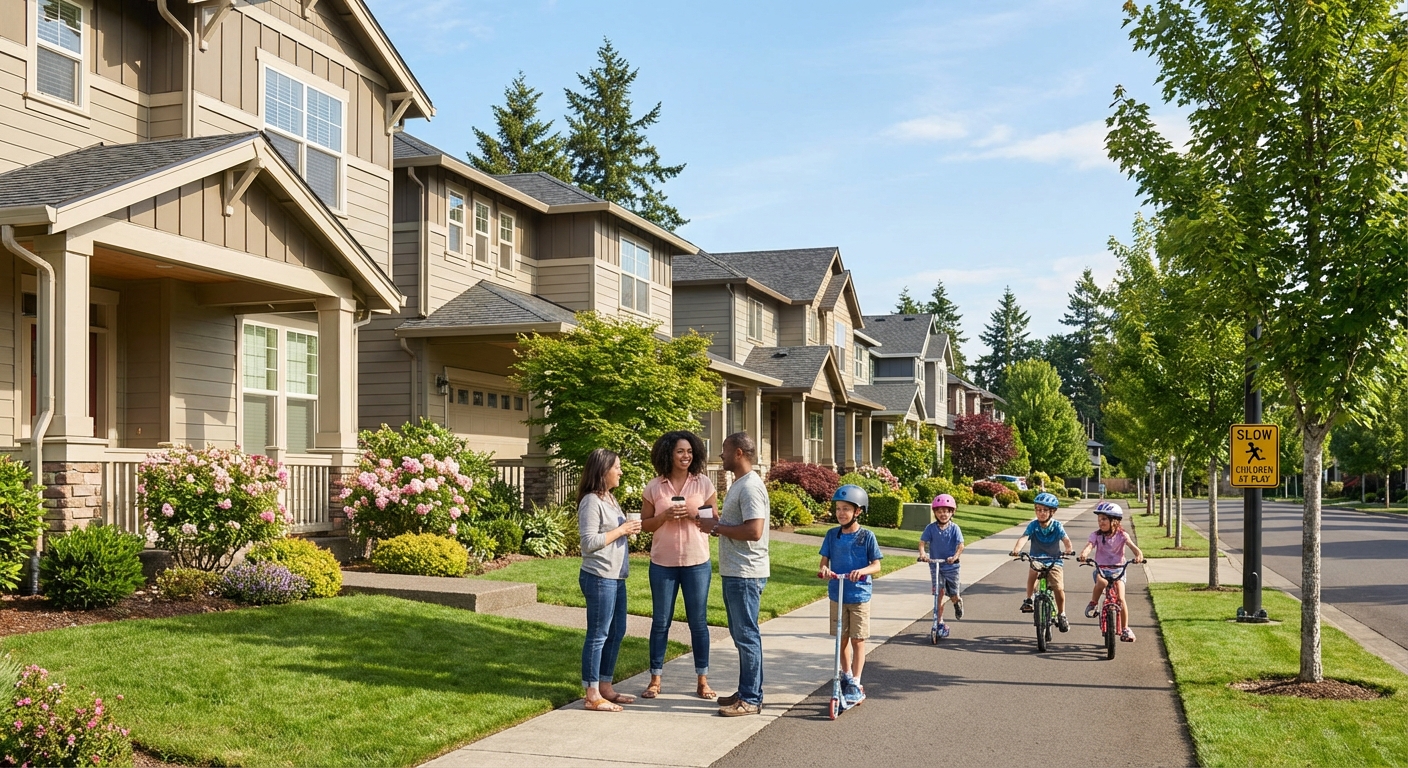
Washington County’s two largest cities offer family-friendly suburbs with excellent schools, diverse communities, and direct connections to the region’s tech economy—but commuting to downtown Portland requires patience.
Beaverton: Diverse, Connected, and Family-Focused
Beaverton serves as the second-largest city in Washington County and a major economic hub, home to Nike’s world headquarters and a growing cluster of tech and manufacturing firms. Housing & Affordability: Diverse housing stock ranges from mid-century ranch homes to modern subdivisions, townhomes, and apartments. Median prices around $550,000 represent significant savings compared to close-in Portland neighborhoods—that difference can mean an extra bedroom, a yard, or simply more financial breathing room. The variety of housing types means Beaverton accommodates everyone from first-time buyers to established families seeking larger homes. Walkability & Transit: Walkability varies dramatically. Downtown Beaverton scores 84 on Walk Score, but city-wide the score drops to 49 (car-dependent). However, Beaverton’s transit infrastructure represents a major advantage: TriMet MAX Blue and Red Lines, plus WES Commuter Rail, provide direct access to downtown Portland and Hillsboro. For those willing to utilize transit, Beaverton offers suburban space with urban connectivity. Schools: The Beaverton School District stands as one of Oregon’s largest and most highly-regarded, boasting a 91% graduation rate and diverse programs including International Baccalaureate, STEM academies, and robust special education services. With a student-teacher ratio around 20:1, the district manages to maintain quality while serving a large, diverse population. For families, this combination of strong academics and programmatic variety often tips the scales toward Beaverton. Demographics & Lifestyle: Beaverton ranks among Oregon’s most ethnically diverse cities, reflected beautifully in its vibrant international food scene—you’ll find authentic Vietnamese, Indian, Middle Eastern, and Japanese restaurants throughout the city. The family-centric culture shows in extensive parks managed by the Tualatin Hills Park & Recreation District (THPRD), a large public library system with robust programming, and cultural amenities like the Patricia Reser Center for the Arts. Beaverton feels thoroughly suburban but avoids cultural homogeneity. Trade-offs: Many neighborhoods lack the unique, walkable character of Portland proper—think wide streets, strip malls, and auto-oriented development patterns. US-26 congestion represents a daily challenge for car commuters heading to Portland; expect significant delays during peak hours. The suburban environment, while family-friendly and practical, simply won’t satisfy those seeking urban grit and walkable density.
Hillsboro: The Silicon Forest’s Affordable Hub
Hillsboro anchors Washington County as the governmental seat and the heart of Oregon’s “Silicon Forest,” hosting major Intel campuses, Synopsys facilities, and numerous other technology companies. Housing & Affordability: Hillsboro generally offers the most affordable housing among locations studied, with median prices around $520,000 and a high concentration of newer single-family homes. Planned communities like Orenco Station (Walk Score 78) provide urban-style walkability in a suburban setting, featuring townhomes, mixed-use development, and pedestrian-friendly design. For first-time homebuyers and families, Hillsboro’s combination of affordability and newer construction represents compelling value. Walkability & Transit: City-wide Walk Score of 41 confirms car-dependency for most residents, though downtown Hillsboro and Orenco Station buck this trend with pedestrian-oriented design. The MAX Blue Line terminates in downtown Hillsboro, providing a transit link to the broader metro area. However, the commute to downtown Portland often exceeds 60 minutes, making this option realistic primarily for those with flexible schedules or strong commitment to transit use. Schools: The Hillsboro School District serves a large, growing population with diverse educational tracks, including dual-language immersion programs that reflect the area’s demographics. With an 84.3% graduation rate, the district performs solidly, though slightly below Beaverton’s numbers. Rapid growth has challenged the district, but ongoing investment in facilities and programs continues to improve educational outcomes. Demographics & Lifestyle: Life in Hillsboro revolves heavily around the tech sector—Intel alone employs over 20,000 people locally. This creates a community of STEM professionals, often transplants from other states and countries, giving Hillsboro an interesting cultural mix despite its suburban character. Entertainment options include the Hillsboro Hops minor league baseball team, a growing brewery scene, and proximity to Oregon wine country in the Tualatin Valley. The lifestyle is decidedly suburban and family-oriented, with newer homes, good schools, and a slower pace than Portland proper. Trade-offs: The commute to downtown Portland is substantial—often exceeding an hour during peak traffic. Cultural and entertainment options, while growing, remain limited compared to Portland. The city’s rapid growth and newer development mean less architectural character and more standardized suburban aesthetics. For some, this represents a fair trade for affordability and proximity to tech jobs; for others, it feels too disconnected from Portland’s urban core.
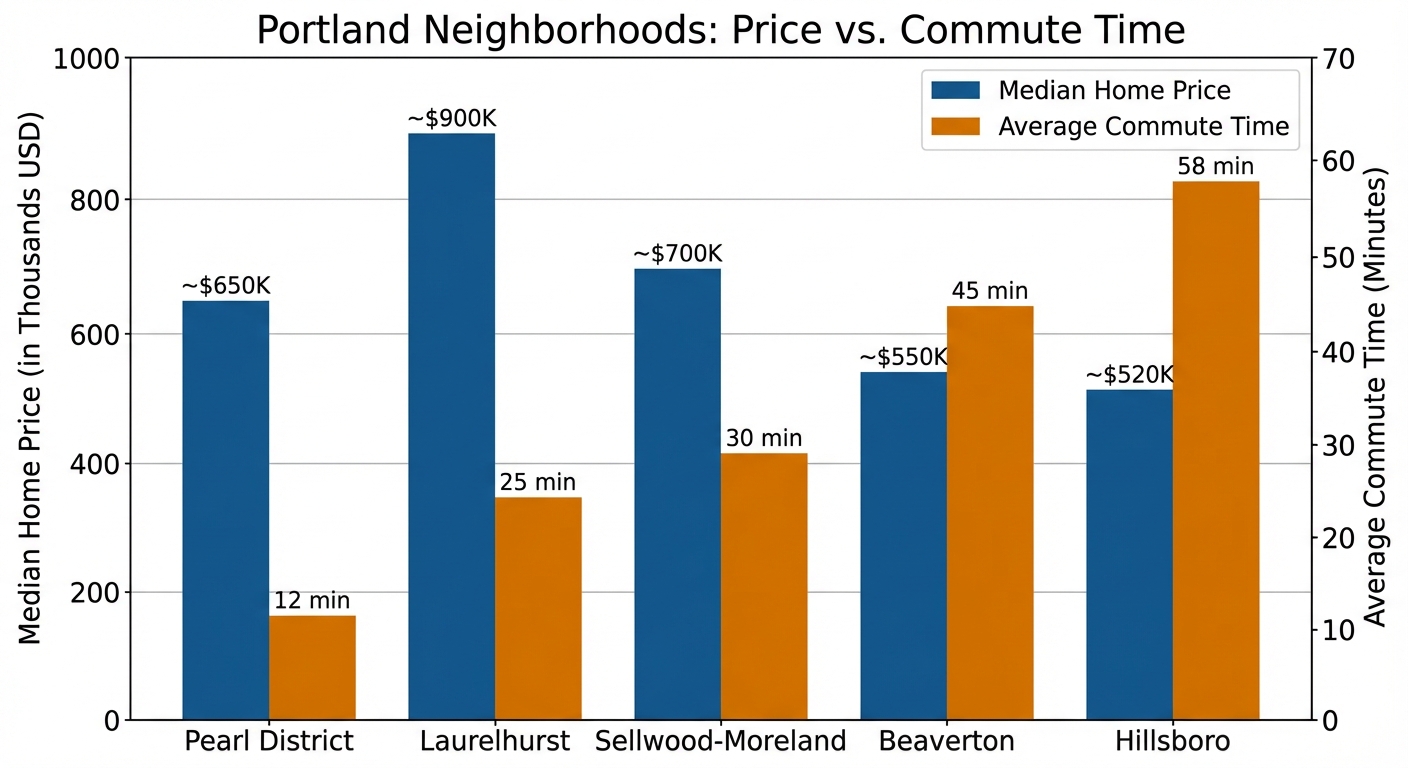
The chart above illustrates the fundamental trade-off many Portland-area buyers face: housing affordability versus commute time. Notice how the suburbs offer significantly lower median prices but substantially longer commutes to downtown Portland. This visualization can help you quantify what you’re gaining and giving up with each location choice.
How to Choose: Three Buyer Personas and Their Ideal Neighborhoods
The “best” neighborhood doesn’t exist—only the best fit for your specific priorities. Here’s how different buyers can apply this data to real-world decisions.
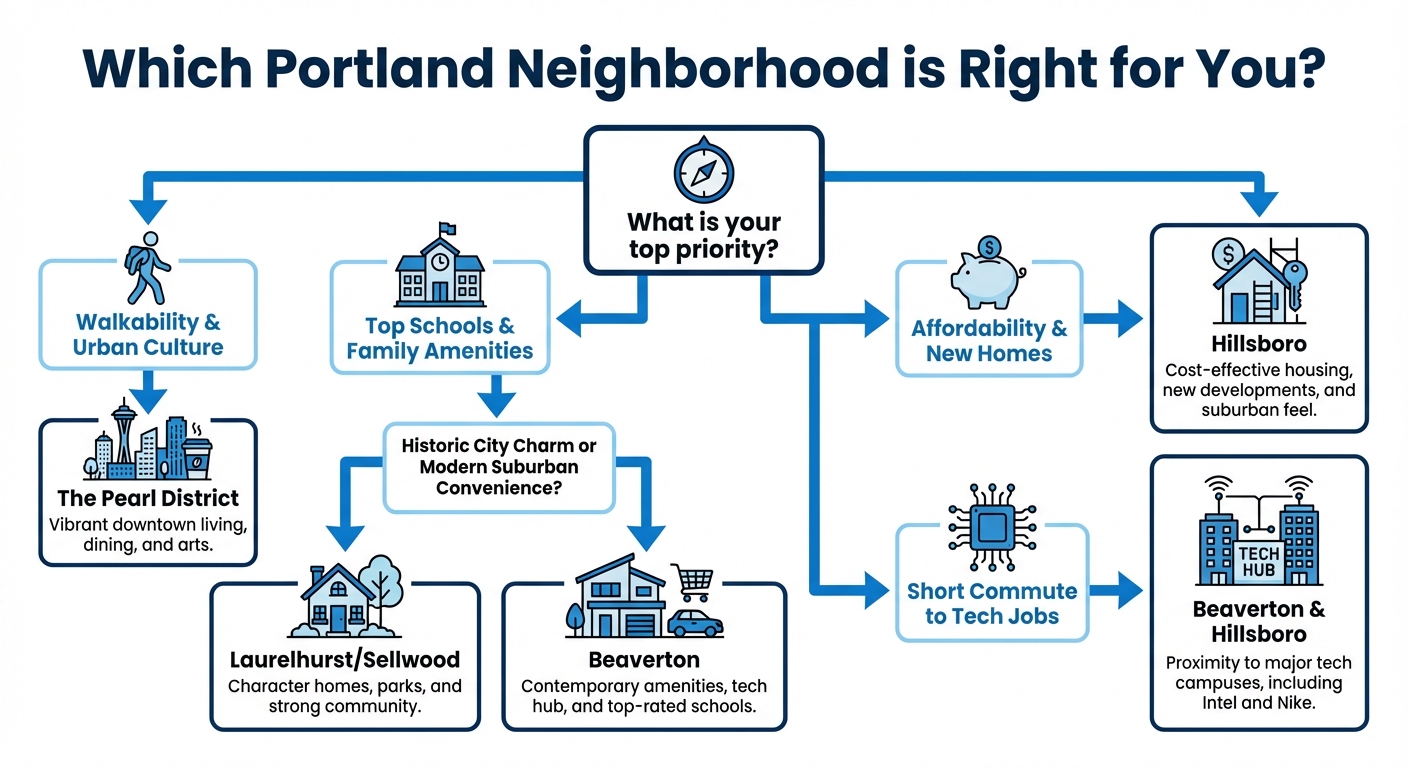
Persona 1: The Dual-Income Tech Professionals
Profile: One partner works for Intel in Hillsboro, the other for a downtown Portland firm. Priorities include commute balance, affordability, and maximizing home value as first-time buyers. Recommendation: Hillsboro. This choice optimizes for the Intel employee’s daily quality of life—imagine a 10-minute commute versus an hour-plus slog from Portland. The downtown-working partner can utilize the MAX Blue Line, which, while long, provides predictable travel time and the ability to work or read during the commute. Lower property taxes and greater affordability in Washington County allow purchasing a larger, newer home than would be possible in Portland, building equity faster. The couple can prioritize weekend trips into Portland for dining and entertainment while enjoying spacious, modern living the rest of the time.
Persona 2: The Family Prioritizing Schools and Community
Profile: Relocating family with school-aged children. Top priorities include a top-tier public school district, safe neighborhood with strong community feel, and a single-family home with a yard where kids can play. Recommendation: Beaverton for its highly-rated school district (91% graduation rate), diverse housing options, and family amenities managed by THPRD. The parks, libraries, and community programming provide ample opportunities for kids to engage in activities and parents to connect with other families. Laurelhurst serves as an alternative for higher budgets and those preferring classic Portland city living—trading suburban space for walkable urban character, historic architecture, and that quintessential Portland neighborhood feel. Both offer strong schools, but the lifestyle trade-offs differ dramatically.
Persona 3: The Urban Enthusiast/Downsizer
Profile: Single professional or empty-nester couple. Priorities include car-free lifestyle, walkable access to nightlife and cultural amenities, and minimal home maintenance (no yards to mow, gutters to clean, or driveways to shovel). Recommendation: The Pearl District. With the highest walkability, best transit access, and densest concentration of dining, art, and entertainment, the Pearl District delivers the ultimate urban lifestyle. Condo living means no exterior maintenance, allowing residents to focus energy on experiences rather than homeownership chores. The ability to walk to Powell’s Books, stroll to dinner reservations, and catch a streetcar to a gallery opening represents the urban ideal. For those who’ve spent years maintaining suburban homes and are ready to trade space for location, the Pearl District is purpose-built for this lifestyle transition.
Final Thoughts
The Portland metro area offers an exceptional range of lifestyles—from the dense, walkable urbanism of the Pearl District to the family-friendly, tech-driven suburbs of Hillsboro. The key to a successful home search is understanding that no single neighborhood is objectively “best.” Instead, the right choice depends on your unique priorities: commute tolerance, school quality, housing budget, and desired lifestyle. By grounding your decision in data—school graduation rates, commute realities, property tax differences, and walkability scores—you can move beyond subjective hype and make a choice that aligns with your long-term goals. The numbers tell important stories:
- Beaverton’s 91% graduation rate versus Portland’s 84.8%
- The Pearl District’s Walk Score of 97 versus Hillsboro’s 41
- Median home prices ranging from $520,000 to $900,000+
- Property tax differentials that can add up to thousands annually
These aren’t just statistics—they’re the building blocks of your daily life experience. They determine whether you’ll walk your kids to school or drive them; whether you’ll spend an hour commuting or ten minutes; whether you’ll pay $5,000 or $10,000 annually in property taxes; and whether you’ll live in a 100-year-old Craftsman or a five-year-old suburban home. As you narrow your search, remember that real estate is deeply personal. Use this guide as a foundation, but don’t skip the in-person research:
- Tour neighborhoods at different times of day to understand traffic patterns and street life
- Test your potential commute during rush hour
- Visit schools and talk to teachers and parents
- Walk the commercial districts to see if the restaurants, shops, and services match your lifestyle
- Connect with local communities through social media groups or community events
The Portland metro area has a place for nearly every type of buyer—you just have to know where to look.
Ready to Find Your Perfect Portland Neighborhood?
Connect with an expert who understands the nuances of each community and can guide you to the right home for your lifestyle and priorities.
References:
- Portland State University Population Research Center. (2023). Annual Population Estimates for Oregon and Its Counties
- U.S. Census Bureau. (2022). American Community Survey 5-Year Estimates, Portland-Vancouver-Hillsboro, OR-WA Metro Area
- S&P Dow Jones Indices. (2024). S&P CoreLogic Case-Shiller Home Price Indices
- Oregon Department of Transportation. (2023). ODOT TripCheck Traffic & Congestion Data
- Walk Score. (2024). Living in the Pearl District, Portland, OR
- Oregon Department of Education. (2023). At-A-Glance School and District Profiles
- Walk Score. (2024). Living in Laurelhurst, Portland, OR
- Walk Score. (2024). Living in Sellwood-Moreland, Portland, OR
- Walk Score. (2024). Living in Beaverton, OR
- National Center for Education Statistics. (2023). Beaverton School District 48J District Details
- National Center for Education Statistics. (2023). Hillsboro School District 1J District Details
- National Center for Education Statistics. (2023). Portland School District 1J District Details
- Metro. (2023). 2040 Growth Concept
- Regional Multiple Listing Service (RMLS). (2024). Market Action Report, Portland Metro Area
- INRIX. (2022). Global Traffic Scorecard
- Oregon Department of Revenue. (2023). Oregon Property Tax Statistics
- National Park Service. (2023). National Register of Historic Places, Laurelhurst Historic District
- City of Beaverton. (2023). Beaverton Community Profile